
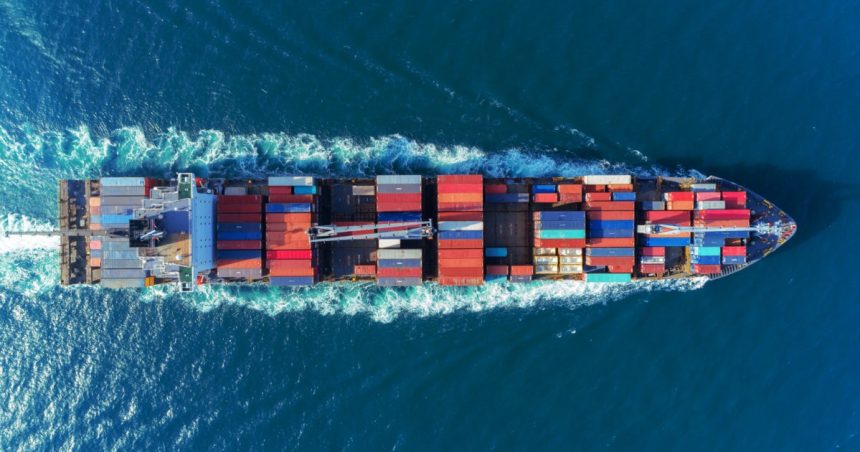
With the increasingly devastating effects of the climate crisis, the global community is racing to cut emissions and adopt sustainable practices to power economies. The global shipping industry, which emits one billion tons of greenhouse gas annually, accounting for 3% of emissions, is under pressure to decarbonize and is at a crossroads this week as countries negotiate a carbon levy on shipping emissions in London.
The proposed levy on the shipping industry’s emissions, the carbon levy, will not only decarbonize global trade but also unlock billions in climate finance. Consequently, this provides a crucial opportunity for the global community to reshape its approach to climate justice by channeling new resources into clean energy, resilient infrastructure, and reducing economic disparity. Moreover, the levy risks raising trade costs for vulnerable economies, presenting a paradox.
The International Maritime Authority has committed to decarbonizing by tackling its annual one billion tons of greenhouse gas emissions to net zero by or around 2050. Negotiations by member states on several proposals for economic and technical measures began on the 7th and are scheduled to close on the 11th, and adoption of the expected consensus is slated for October 2025.
According to the World Bank, if set at $100 per tonne, a universal levy on carbon emissions from shipping can raise approximately $60 billion a year.
What Does the Levy Mean for Africa?
The shipping levy presents a paradox of risks and opportunities for vulnerable countries in the global south. The levy would increase trade costs, posing risks to the food security of many vulnerable countries and impacting national economies.
Amb. Ali Mohamed, Kenya’s Special Envoy for Climate Change, emphasizes that decarbonization should not penalize vulnerable economies.
“Even as we welcome this levy, it is important to keep in mind that African economies cannot afford charges that inflate trade costs and widen global economic disparities,” he says.
Besides the immediate threat of rising trade costs, the existing structural imbalances spell disadvantage for Africa in the seafarer’s negotiation. Stanley Raja Korshie Ahorlu, President of, Ghana Chamber of Shipping, emphasizes that Africa’s needs should be addressed in the negotiation pointing out, woeful fleet ownership, lack of ship finance, low representation in the global seafarer community, countless cadets unable to secure mandatory sea time on the world’s ships, underdeveloped port infrastructure, energy poverty, amongst others.
“A win-win outcome would result in high-ambition climate action and addresses some of the needs enumerated,” he says.
He further adds that Africa is not coming to the negotiating table empty-handed saying, “The continent has a youthful population of 1.4 billion, a combined market valued at more than USD three trillion, annual imports in excess of 35 million TEU, vast coastal and inland waterways, and immense natural resources for renewable energy production, just to name a few.”
These immense resources provide opportunities for the continent to exploit and set itself apart in the race to transition as a future supplier of green hydrogen and renewable maritime fuels.
How Much Will Flow to Developing Nations?
The revenue distribution, pricing, and scope are still under negotiation. However, Africa is pushing for a legally binding redistribution mechanism, and there is increasing support for directing a portion of the proceeds to assist vulnerable nations, especially Small Island Developing States (SIDS) and Least Developed Countries (LDCs), which would go beyond the maritime industry to provide adaptation and mitigation measures.
According to Eldine Glees, Maritime Policy Advisor, Micronesian Centre for Sustainable Transport, “A global carbon levy on shipping is a rare chance to turn climate risks into investments.”
Faten Aggad, Executive Director of African Future Policies Hub emphasizes that for any measure to be acceptable, the polluter pays principle should remain at the center of the negotiations.
Africa’s asks;
- An indicative figure that clearly shows a fair and transparent revenue distribution for developing countries based on climate, social, and economic needs
- If redistributions are to reflect the principle of polluter pays, they should be in the form of grants, not loans or interest-bearing instruments
- Ensuring that food security is not further compromised and mitigating the levy’s disproportionate impact on African economies
- Securing non-interest-bearing capital to fund Africa’s green transition without limiting fund use to the shipping sector alone.
- Due consideration be given to the existing structural imbalances and, where possible, partial or temporary exemptions be applied to African exports
Upon consensus on a fair levy design, a successful redistribution of climate finance resources would avoid the widening of inequalities across the globe. It would give vulnerable countries an opportunity to explore the robust potential of green energy production and build climate-resilient economies. However, as negotiations continue, questions remain whether this levy will be another burden in an already heavy trade system.

Your writing is not only informative but also incredibly inspiring. You have a knack for sparking curiosity and encouraging critical thinking. Thank you for being such a positive influence!