
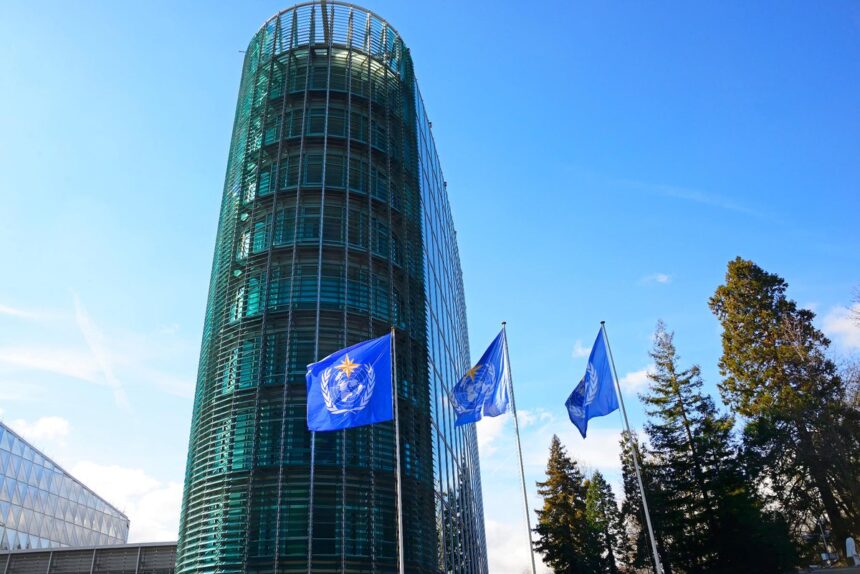
As climate change intensifies, millions still lack basic protection against deadly storms and floods. The World Meteorological Organization (WMO) is pushing to change that, and fast.
The World Meteorological Organization (WMO) is celebrating its commendable 75-year journey, which began with the understanding that weather, water, and climate respect no national boundaries.
To advance this vision, WMO has organized a convention of its 193 member states, focusing on how they can further accelerate and expand the global Early Warnings for All (EW4All) initiative. This initiative, launched by United Nations Secretary-General António Guterres in 2022, aims for universal coverage by the end of 2027.
This meeting, therefore, marks more than just WMO’s anniversary as the UN’s specialized agency for weather, climate, and water. It showcases the organization’s vital role in fostering global collaboration in observation, forecasting, and data sharing.
Notably, the number of countries with life-saving early warning services has more than doubled over the past ten years. However, significant gaps remain, leaving millions without protection from dangerous weather events that are increasingly damaging economic assets and critical infrastructure.
WMO Secretary-General Celeste Saulo emphasized that the organization’s history is rooted in solidarity, cooperation, shared data, innovation, and trust. She added that resilient development, food security, infrastructure planning, and disaster risk reduction cannot occur without the collective services, science, and infrastructure that the organization provides.
“Our slogan, Science for Action, sums up WMO’s immense contribution to global economic and social well-being. That same conviction inspires the Early Warnings for All initiative. It is Science for Action and Science in Action,” she said.

The Growing Reach of Early Warnings for All
Early Warnings for All (EW4All) is a bold initiative launched by the UN Secretary-General, setting an ambitious goal: by 2027, every person on Earth will be protected by multi-hazard early warning systems.
The initiative is spearheaded by WMO, alongside the UN Office for Disaster Risk Reduction (UNDRR), the International Telecommunication Union (ITU), and the International Federation of Red Cross and Red Crescent Societies (IFRC). Together, they cover the full value chain: from observations and forecasting to disaster risk knowledge, warning dissemination, and response preparedness.
Moreover, the initiative now includes various partners: UN agencies, development banks, humanitarian organizations, academia, and private sector actors, from meteorological equipment manufacturers to tech companies.
While the initial focus was on 30 high-risk countries, the target group has since expanded. Importantly, national ownership remains central, with governments taking the lead.
According to Celeste Saulo, the Early Warnings for All is now more than an initiative rather it embodies a brand for global solidarity. “Together we are saving lives, shaping policy, and strengthening resilience,” she said.
EW4ALL has become essential, as evidenced by how, over the last 50 years, weather, water, and climate-related hazards have claimed over 2 million lives, with 90% of those deaths occurring in developing countries. Economic costs and impacts are spiraling as the weather becomes more extreme.
While significant progress has been made in implementing EW4All, much work remains. It’s apparent that as of 2024, 108 countries report having some capacity for multi-hazard early warning systems, more than double the 52 countries in 2015, and this has increased further in 2025.
The initiative has been well embraced as many countries have drawn up national roadmaps, bringing together all sectors of government and society, and are implementing programs on the ground that make a real difference in saving lives.
However, some gaps remain, as disaster mortality is six times higher and the number of people affected is four times higher in countries with limited multi-hazard early warning systems.
“The success of Early Warnings for All is not measured in reports or resolutions, but in lives saved and livelihoods protected. This report is both a record of progress and a call to action,” writes Celeste Saulo in the foreword.

Hazard Monitoring and Forecasting
A new report will be launched at the Extraordinary Congress, Early Warnings for All in Focus: Hazard Monitoring and Forecasting – the “pillar” which is under WMO’s responsibility.
It tracks global progress and gaps in the detection, monitoring, forecasting, and warning across the hydrometeorological value chain, including for hazards such as tropical storms, floods, sand and dust storms, and extreme heat.
The numbers highlight the collective progress but also the scale of the task ahead:
- Sixty-two assessments of the hydrometeorological value chain revealed that half of the countries possess only basic capacity, and 16% have less-than-basic capacity. The situation is worse in fragile, conflict, and violence-affected contexts.
- Compliance with the Global Basic Observing Network (GBON) requirements remains low, particularly in Least Developed Countries and Small Island Developing States. However, more compliant stations are coming online, networks are increasingly automated, and reporting frequency is improving.
- The number of surface stations sharing data via the WMO Information System (WIS) has grown by about one-fifth since 2019, while daily observations and daily reports per station have increased by around 60%. This means fewer false alerts and extended lead times for early warnings.
- The launch of WIS2 in 2025 represents a transformational step in global data exchange because it eliminates the need for costly specialized equipment, enabling even the smallest National Meteorological and Hydrological Services (NMHSs) to participate fully. It stands as a model of international cooperation, jointly operated by advanced centers across 11 Members.
- Satellite capabilities are expanding, but gaps remain. Although 56% of Members use satellite data for at least one hazard, only 20% do so for all their priority hazards. Regional partnerships are beginning to close these gaps by combining hardware, training, and institutional capacity-building, tailored to regional needs.
- The WMO Integrated Processing and Prediction System (WIPPS) global network of over 150 designated centers ensures that all NMHSs can access state-of-the-art forecast products, regardless of their own modeling capacity. 76% of Members are using WIPPs products, bridging capacity gaps for those without their own systems.
- The Severe Weather Forecasting Program (SWFP) continues to grow. As of 2025, it provides operational support to 85 Members across nine subregions.
- Digital innovation and the use of Artificial Intelligence have huge potential to help developing countries without supercomputers leapfrog to more advanced capabilities. But the digital divide remains wide.
The report gives impactful case studies of countries that have made great strides, including through WMO project support and examples of South-South cooperation.
Saulo emphasized that it’s evident how global solidarity, guided by science and driven by partnership, can deliver transformative change. “As we look toward 2027, let us redouble our efforts to ensure that no one, no matter where they live, is left unprotected,” urged Saulo.
