
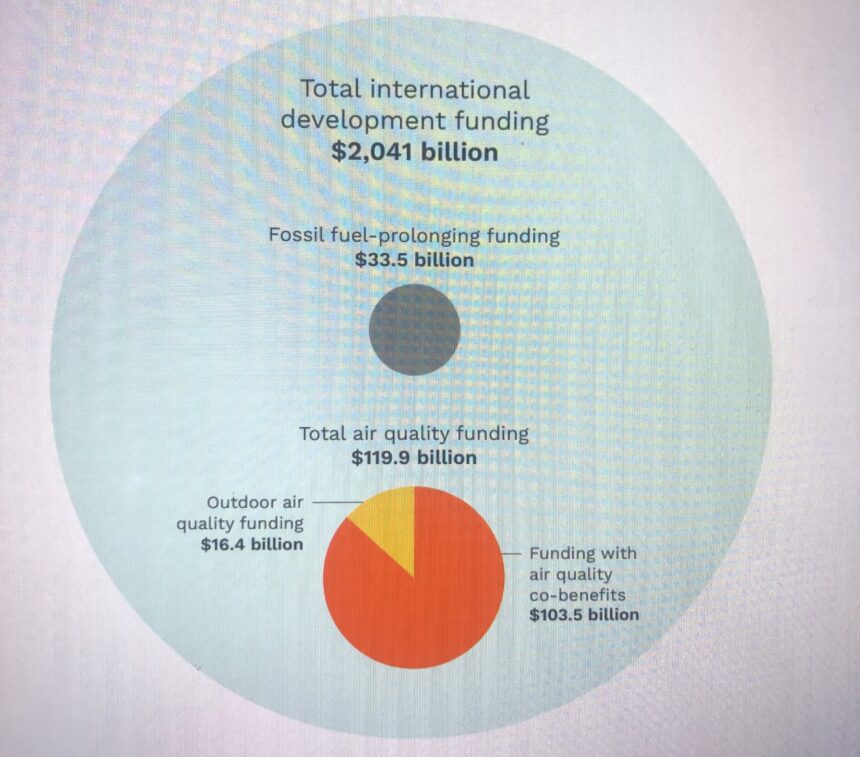
International development funding for outdoor air quality fell sharply in Africa in 2023, even as pollution remains one of the continent’s biggest health risks.
Steve Umidha, One Planet Agency
Africa wants a larger share of global funding for outdoor air quality as governments face worsening urban pollution and its growing health and economic costs.
Air pollution was linked to an estimated 1.2 million premature deaths and 54 million years of healthy life lost across Africa in 2021, according to the Health Effects Institute and the Clean Air Fund. It is now the continent’s second biggest threat to health, behind malnutrition.
Still, Africa receives less than 1% of global outdoor air quality funding from governments and development finance institutions, according to the Clean Air Fund’s State of Global Air Quality Funding 2025 report.
The gap is particularly stark in sub Saharan Africa, where funding fell by 91% between 2022 and 2023, from $129 million to just $12 million.
Across Africa as a whole, outdoor air quality funding fell 69% over the same period, from $519 million to $161 million.
The decline came as several African countries faced some of the highest levels of air pollution in the world.
Five of the 10 most polluted countries in 2023 were in sub Saharan Africa, yet less than $1 per person in air quality financing reached those countries, the report found. Egypt was the only African country among the 10 largest recipients between 2019 and 2023, accounting for 5% of global outdoor air quality funding.
Globally, funding has also remained concentrated.
Between 2019 and 2023, 65% of outdoor air quality funding went to just three countries, the Philippines, Bangladesh and China.
The Clean Air Fund says air quality remains poorly integrated into development finance, with funding often directed towards other priorities even when projects could also reduce pollution.
Martina Otto, head of the Climate and Clean Air Coalition Secretariat at the UN Environment Programme, said greater investment in clean air could support wider development goals.
“Clean air is not only a public health imperative, but it is also an investment in sustainable development, resilient cities, and economic opportunity,” Otto said.
She has called for a dedicated platform bringing governments, civil society, funders and researchers together to accelerate action on clean air and short lived climate pollutants.
Such action could include stronger clean air policies, regional cross border partnerships and better systems for using air quality data to guide decisions.
Funding is falling as cities grow
The funding gap comes as Africa undergoes rapid urbanisation.
The Clean Air Fund says Africa is experiencing the fastest rate of urbanisation in the world, increasing the number of people exposed to pollution from traffic, industry, power generation and other sources.
That makes better air quality data increasingly important.
Yet more than 35% of African countries do not have a single continuous air quality monitoring station, according to the Africa Clean Air Network.
Without reliable data, governments can struggle to identify pollution hotspots, measure changes or determine whether policies are working.
This is one reason African researchers and governments are increasingly pushing for locally led monitoring and policy solutions rather than relying solely on international funding.
Ghana, for example, has been expanding the use of air quality sensors while working on clean air measures covering transport, energy and household pollution. The country has also been involved in the Africa Clean Air Programme, which brings together more than 100 African experts to develop a regional roadmap for reducing air pollution.
The challenge is therefore not simply to attract more money.
It is also to make air quality part of investments that are already being made in transport, energy, waste management and urban development.
The Clean Air Fund says projects with air quality benefits but without air pollution as their main stated objective received $28.8 billion in 2023, up from $27.1 billion the previous year. Such projects include electric vehicle programmes and initiatives that reduce the burning of agricultural waste.
That suggests a larger pool of money could potentially contribute to cleaner air without being classified as air quality funding.
But the direct funding gap remains.
In 2023, global support for clean air was about 1% of international development finance, even as funding for projects that prolong fossil fuel use rose by 80% to $9.5 billion, according to the Clean Air Fund.
The continent now seeks ways to make clean air part of the continent’s development plans rather than treating it as a separate environmental concern.
One Planet Agency
