
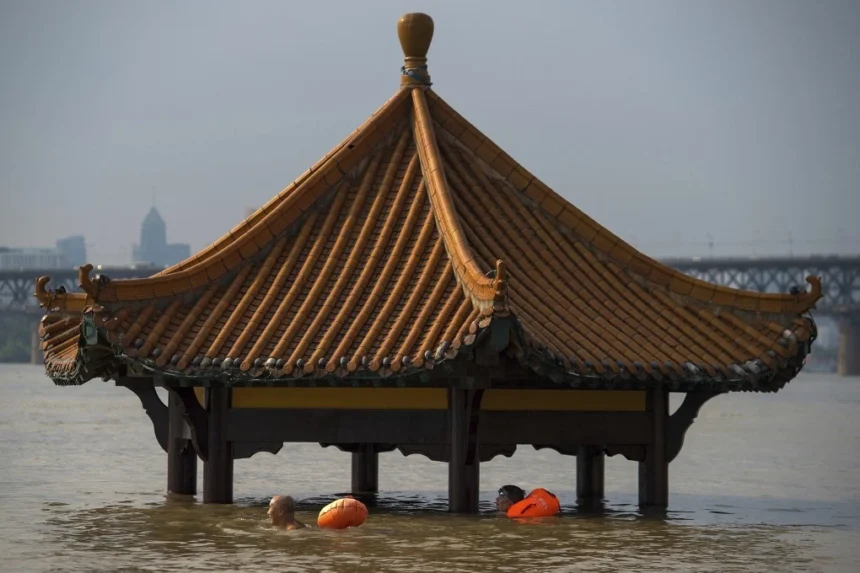
Research by a team of scientists, led by Rutgers University researchers, has found that the rise of modern sea level has been accelerating faster than ever in the past 4000 years. Moreover, China’s coastal megacities are among the most at risk.
The study, published in Nature, incorporated data spanning nearly 12,000 years since the last major ice age and found that global sea levels have risen by an average of 1.5 millimeters per year since 1900, faster than any century-long period in the past four millennia.
“Since 1900, sea levels have been rising at the fastest rate in at least 4,000 years,” said Yucheng Lin, a former Rutgers postdoctoral associate and now a scientist with Australia’s national research agency, CSIRO, in Hobart.
China’s Coastal Cities Face a Double Threat
The global concern is that, as the planet heats up, the oceans swell as they absorb more heat, while melting glaciers and ice sheets in Greenland and Antarctica pour vast volumes of water into the seas, fueling global sea level rise.
However, experts are increasingly worried about China’s megacities, Shanghai, Shenzhen, and Hong Kong, located in delta regions where soft, waterlogged sediments are sinking, a problem made worse by both nature and human activity.
“We’ve been able to quantify the natural rate of sea level rise for this area,” Lin said. “But human intervention, mostly groundwater extraction, makes it happen much faster.”
For instance, in Shanghai, parts of the city sank more than one meter (around three feet) during the 20th century because of extensive groundwater pumping, Lin said. That rate is vastly higher than the current global average for sea level rise.
Delta regions have always attracted civilization and development. They are naturally flat and fertile, ideal for farming, transport, and urban development. However, those same features make them exceptionally vulnerable to flooding.
According to Lin, centimeters of sea level rise will greatly increase the risk of flooding in the deltas.
“These areas are not only important domestically; they’re also international manufacturing hubs. If coastal risks happen there, the global supply chain will be vulnerable,” he said.
Efforts to Slow the Sinking & a Global Lesson
Despite the concerning data, the scientists are optimistic as some Chinese cities have begun taking effective steps to manage the problem.
Shanghai, for instance, is controlling groundwater extraction and reinjecting freshwater into underground aquifers. This has slowed the sinking considerably.
Although the study focuses on China, its implications reach far beyond. In Africa, Coastal cities like Lagos, Mombasa, and Alexandria are already experiencing the combined effects of rising seas, rapid urbanization, and land subsidence from groundwater extraction.
In low-lying areas, even small increases in sea level are translating into severe flooding, erosion, and saltwater intrusion, threatening millions of lives and billions in infrastructure.
Scientists warn that without adaptive urban planning and resilient coastal defenses, the continent’s economic hubs could face recurring climate-induced disruptions.
Read Also: How Rising Seas are Toppling Historic Cities
