
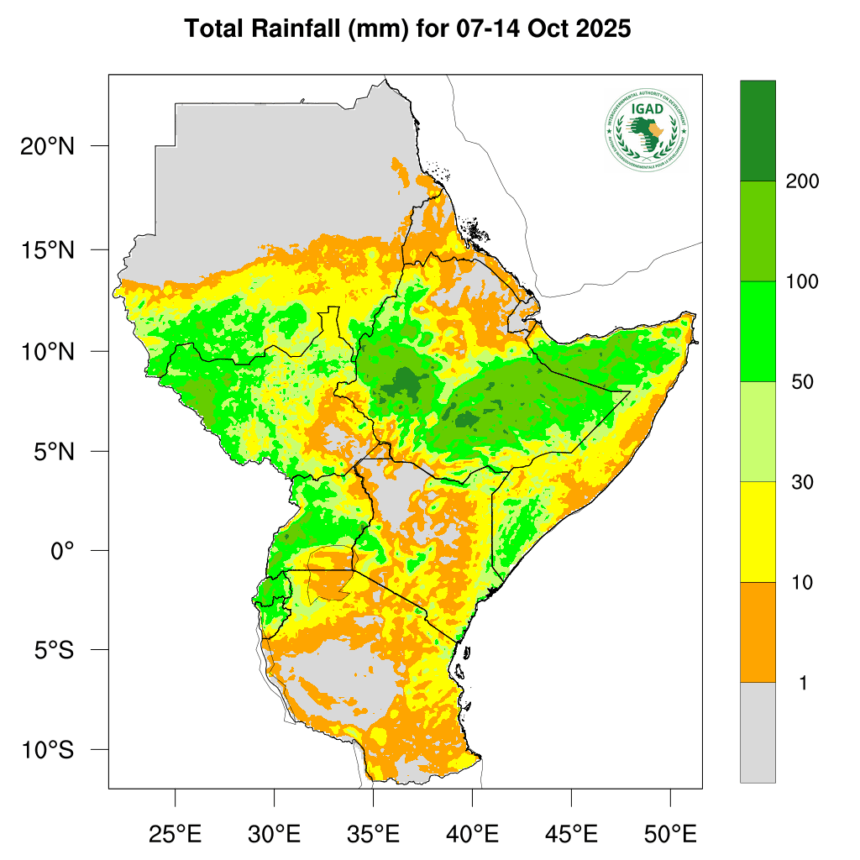
As October settles in, the Greater Horn of Africa (GHA) enters another critical week of weather volatility, marked by heavier-than-normal rainfall in some regions and intensifying heat in others, according to the forecast for the week of 7–14 October 2025.
The latest climate outlook from IGAD-ICPAC reveals a region once again confronting the tension between excess and scarcity, between too much rain in already saturated lands, and too little where thirst still lingers from past droughts.
Heavy Skies Over the Greater Horn of Africa in Somalia, Ethiopia, and South Sudan
According to the forecast, Southern Ethiopia is expected to bear the brunt of the rains this week, with forecasts exceeding 200 millimeters in select areas, enough to trigger localized floods, challenge mobility, and threaten rural settlements.
This level of precipitation, particularly in flood-prone regions, can easily overwhelm local infrastructure and recovery efforts.
Meanwhile, moderate rainfall (50–200mm) is anticipated across northern and southern Somalia, western and central Uganda, Rwanda, northern Burundi, western South Sudan, and south-western Sudan.
These rains, though less extreme, remain vital for replenishing soil moisture and supporting crops, especially for farming communities that have been teetering between dry spells and flash floods.
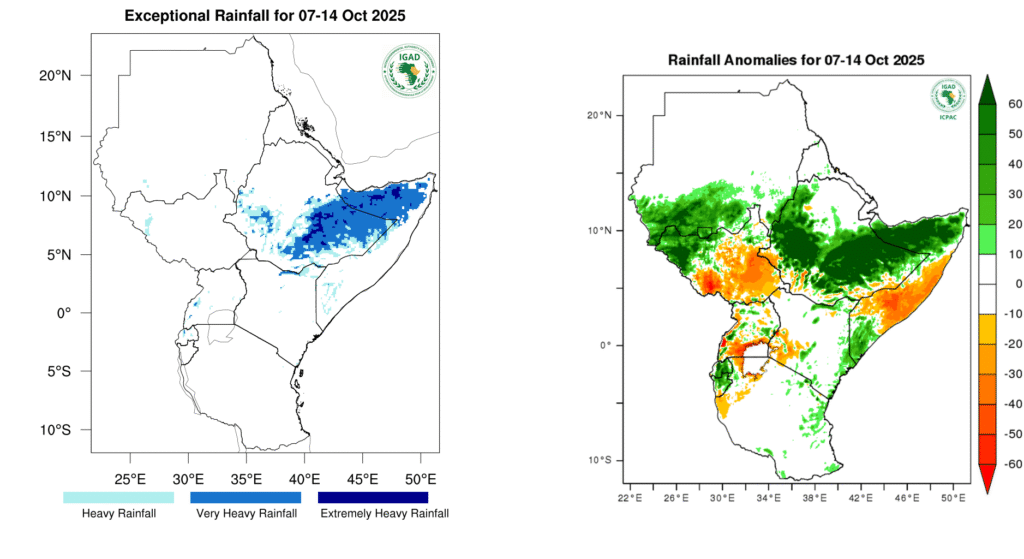
However, where the clouds gather most intensely, the concern grows deeper: exceptional rainfall, projected to exceed the 95th percentile of historical records, is expected in south-eastern Ethiopia and northern Somalia. These are statistical extremes, events that are rare, powerful, and often destructive.
While some areas prepare for too much rain, others once again face the sting of scarcity. Central and southern Somalia, parts of southern Ethiopia, and central South Sudan are forecast to receive less rainfall than usual, a worrying signal for communities already grappling with reduced harvests, drying water points, and deepening food insecurity.
In regions like southern Uganda and western Kenya, the below-average rainfall adds strain to already fragile growing seasons. For smallholder farmers, especially those who rely on each season’s success for their survival, this unpredictability becomes more than a challenge; it becomes a threat to livelihood.
Heat Rising Across the Greater Horn of Africa
As the rains fall in some areas, others will endure heat that presses down like a second hardship. Temperatures above 32°C are expected in the Afar region of Ethiopia, while much of Sudan, South Sudan, Somalia, Eritrea, and Djibouti will experience highs between 20–32°C, warmer than seasonal averages.
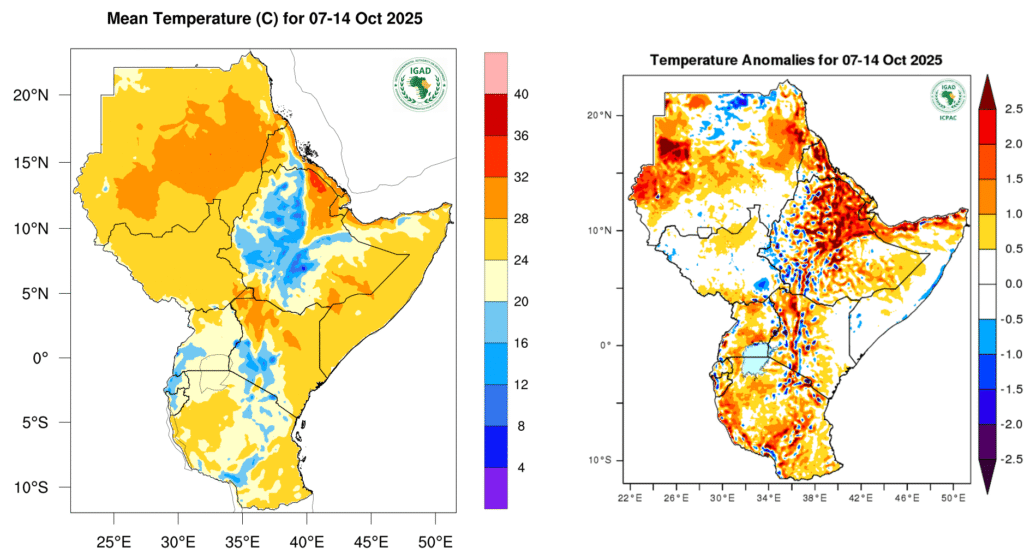
Heat stress warnings have been issued, particularly for the Red Sea coast and the Afar lowlands, where compounded heat and dryness may strain both people and livestock. In rural areas without consistent access to cooling, water, or medical care, such conditions can be deadly.
Yet not all regions will feel the same intensity. Central Ethiopia, south-western Kenya, and the highlands of Rwanda and Burundi are expected to enjoy milder temperatures under 20°C, offering a brief reprieve from the region’s otherwise escalating heat trends.
Balancing Between Extremes in GHA
This latest outlook reinforces a hard truth: the Greater Horn of Africa is increasingly navigating climate extremes. One part floods, another dries. One community prepares for evacuation, while another digs deeper to reach water.

Even though through it all, the human story is not only one of vulnerability, it is also one of resilience.
In Ethiopia’s central-western highlands, flood-prone villages are reinforcing riverbanks and raising homes on stilts. In parts of Somalia, pastoralists are adjusting migration routes in anticipation of poor rainfall.
Across Uganda and Kenya, community groups are working with local authorities to improve drainage systems, share water more equitably, and protect harvests through climate-smart farming techniques.
Experts continue to raise alarms about the potential for crop damage, infrastructure loss, and health crises from both flooding and heat. But they also point to increased preparedness, better early warning systems, and community-level adaptation strategies that have slowly begun to take root across the region.
A Region Rising, Not Just Bracing
For the Greater Horn of Africa, forecasts like these are no longer rare warnings; they are recurring chapters in an unfolding climate story.
Although within that story lies a growing recognition that survival is no longer enough. Adaptation, innovation, and community solidarity are becoming essential tools for facing the seasons ahead.

As the skies grow heavier and the air grows hotter, people across the Horn are not standing still. They are digging in, adapting, and preparing, not with ease, but with enduring courage. Because in this region, resilience is not just a word in a report, it’s a way of life.
