
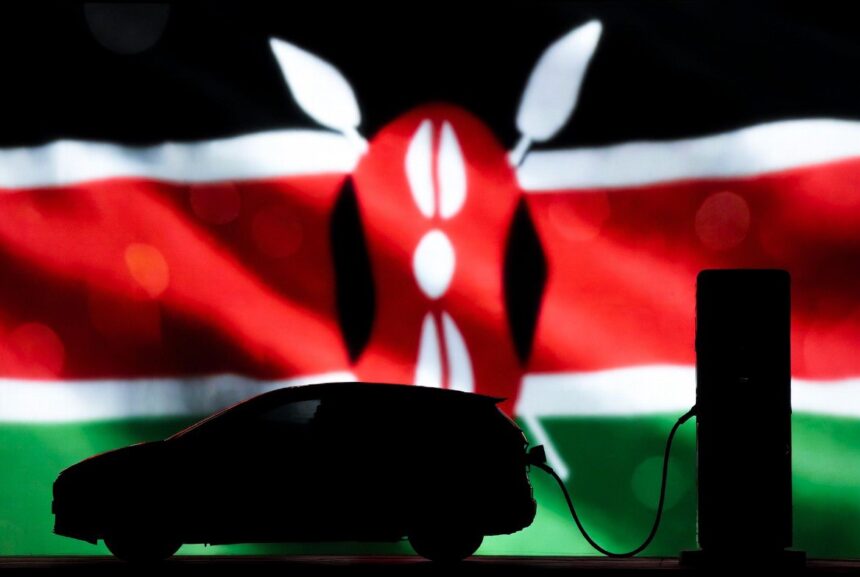
There is appetite for Chinese EVs but sparse charging infrastructure and taxes still discourage adoption.
Seth Onyango and Derrick Opar, One Planet Agency
Kenya’s push toward cleaner transport is accelerating as cheaper electric vehicles from China enter the market, raising questions about whether they could meaningfully shift the country away from its long‑standing reliance on second‑hand petrol cars.
According to the Kenya Revenue Authority, the country imports between 70,000 and 80,000 vehicles annually, with about 80% arriving as used units through the port of Mombasa.
Electric vehicles remain a small fraction of this flow, accounting for 0.2% to 5% depending on whether electric motorcycles are included. But the numbers are rising quickly.
“At the start of 2025, Kenya had registered 39,324 EVs, up from 1,378 in 2022, representing more than 2,700% growth in three years,” Cabinet Secretary for Roads and Transport Davis Chirchir said at the launch of the National Electric Mobility Policy.
The government has introduced incentives to support this shift, including zero VAT on electric buses, bicycles, motorcycles and lithium‑ion batteries, and zero excise duty on electric two‑wheelers.
These measures have helped spur demand, reflected in rising electricity consumption by the transport sector. Kenya Power reported a 188% increase in EV‑related electricity use in 2025, reaching 8.43 million kWh.
Yet the economics of EV ownership remain shaped by Kenya’s tax regime. Imported vehicles are subject to five major taxes based on the CIF value: 25%–35% import duty, 20%–35% excise duty, 16% VAT, a 3.5% Import Declaration Fee, and a 2% Railway Development Levy.
While EVs benefit from reduced or zero‑rated components of this structure, the cumulative burden still affects retail prices.
Local assembly is emerging as one way to reduce costs. TAD Motors, Kenya’s first domestic EV brand, assembles vehicles at the Naivasha Special Economic Zone, importing only batteries, electronics and select components from China.
Its entry‑level Amani EV starts at KES 1 million (USD 7,140), while its top‑end Dhahabu EV begins at KES 2.3 million (USD 16,430). The company says its goal is to make electric mobility accessible to “everyday Africans.”
Chinese manufacturers are also reshaping the landscape. BYD, which overtook Tesla in 2025 to become the world’s largest EV seller, has expanded aggressively into emerging markets.
Analysts say unsold inventory — new but discounted — could increasingly be diverted to Africa, offering vehicles cheaper than brand‑new imports and in better condition than typical second‑hand units.
A recent analysis by Autos Kenya shows the operating cost advantage is substantial: KES 15.38 per km (USD 0.11) for petrol versus KES 1.75 per km (USD 0.012) for electric. A driver covering 1,500 km a month would spend KES 2,625 (USD 18.75) on charging compared to KES 23,070 (USD 165) on petrol — a saving of KES 20,445 (USD 146).
Infrastructure remains a constraint. “Charging infrastructure is concentrated around Nairobi and should be expanded to other towns across the country,” said Dr. Juma Mukhwana, Principal Secretary for Industrialisation.
Kenya Power operates public chargers mainly in the capital, while private firms such as Ecotrify and UTU Africa install home wall boxes. Charging costs range from KES 20–30 per kWh (USD 0.14–0.21) at home to KES 45–60 per kWh (USD 0.32–0.43) for DC fast charging.
Across the region, Ethiopia offers a parallel example. The government has banned the import of internal combustion engine vehicles and introduced tax exemptions for EVs, prompting a surge in Chinese brands entering the market.
The policy shift has accelerated local assembly and positioned Ethiopia as one of Africa’s fastest‑growing EV adopters.
Whether Kenya follows a similar trajectory may depend on how quickly prices fall. If Chinese EVs continue to arrive at lower cost — and if charging networks expand beyond Nairobi — analysts say the country’s dependence on second‑hand petrol cars could finally begin to weaken.
OPA News Agency
