One Planet AgencyOne Planet AgencyOne Planet Agency
  • Home
  • Climate News
    • Politics
    • Justice
    • Finance
    • Business
    • Nature
    • Science
    • Carbon Markets
    • Explainers
    • Series
    • All news
  • Climate Tech
    • AI and climate
    • Campaigns
    • Companies
    • Innovations
    • Science
    • Training
  • Green Markets
  • People & Voices
    • Interviews
    • Opinion
    • Women
    • Guest Writers
  • Energy
  • Deep Dives
    • Investigate
    • Expert Opinion
    • Analysis
  • Multimedia
    • Pictures
    • Videos
    • Podcast
Reading: Timing shields east and southern Africa from fertiliser price spike 
Share
Notification Show More
Font ResizerAa
Font ResizerAa
One Planet AgencyOne Planet Agency
  • Home
  • Climate News
  • Climate Tech
  • Green Markets
  • People & Voices
  • Energy
  • Deep Dives
  • Multimedia
  • Home
  • Climate News
    • Politics
    • Justice
    • Finance
    • Business
    • Nature
    • Science
    • Carbon Markets
    • Explainers
    • Series
    • All news
  • Climate Tech
    • AI and climate
    • Campaigns
    • Companies
    • Innovations
    • Science
    • Training
  • Green Markets
  • People & Voices
    • Interviews
    • Opinion
    • Women
    • Guest Writers
  • Energy
  • Deep Dives
    • Investigate
    • Expert Opinion
    • Analysis
  • Multimedia
    • Pictures
    • Videos
    • Podcast
Have an existing account? Sign In
Follow US
One Planet Agency > Blog > Africa > Timing shields east and southern Africa from fertiliser price spike 
AfricaAgricultureClimate NewsWorld

Timing shields east and southern Africa from fertiliser price spike 

By Seth Onyango Last updated: April 9, 2026 4 Min Read
Share

Africa’s exposure to a fertiliser price surge is uneven, with early planting before the war in Iran sparing some regions and leaving others exposed.

Seth Onyango, One Planet Agency

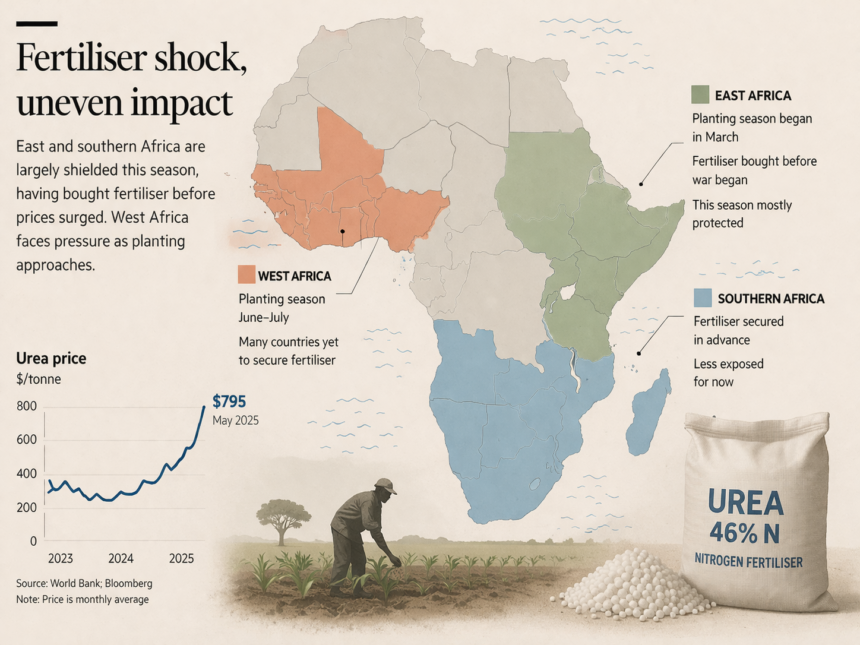
East and southern Africa have, for now, avoided the sharpest effects of a surge in global fertiliser prices triggered by the Israel–US war with Iran, according to the World Bank’s chief economist for the region.

Prices of urea, a widely used nitrogen fertiliser, have risen by about 95 per cent since the start of the year to roughly $795 a tonne, reflecting tightening supply and rising input costs linked to the conflict.

Yet the timing of the agricultural calendar has given parts of the continent a buffer.

Andrew Dabalen, the World Bank’s chief economist for Africa, said the current planting season in eastern Africa is largely protected because farmers secured inputs before prices spiked.

“In Eastern Africa, the planting season started in March, and typically procurement for fertiliser gets done maybe a couple of months before that,” Dabalen told CJTN.

“So this season’s planting season is actually okay, right? The rains are, they’ve been normal. The fertiliser was probably procured before the war started, and so this season is going to be potentially fine.”

That window of stability may not last.

Dabalen warned that the next planting cycle could come under pressure if the conflict continues and supply remains constrained.

“What will be the most worrying will be if this war drags on for a long time, the procurement for the following season,” he said.

Domestically, he added “it’s possible that, in fact, if there is no alternative sources of fertiliser supply in the next planting season, you could begin to see domestic production shortfalls rapidly emerge.”

The risk extends beyond regional supply chains. A prolonged disruption to fertiliser markets could affect global agricultural output, limiting availability and pushing prices higher across multiple commodities.

“Now, alternatively, if this is global, right, we should expect that, in fact, the shortages of fertiliser are going to be global. Global food production will also decline,” Dabalen said.

“And so even if you were to go outside and try to import for your shortfall, you might actually end up either not having access because there are a lot of people competing, there are a lot of countries competing for that lower supply, or you might begin to actually pay huge, you know, highly elevated prices, in which case then that gets translated through the domestic inflation and therefore food scarcity.”

The divergence across the continent is becoming clearer as planting seasons shift.

While eastern Africa has already sown its crops, West Africa is approaching a critical period. Its main planting season begins in June and July, and many countries have yet to secure fertiliser supplies.

“At the moment, West Africa’s planting season is ahead. It’s in June or July,” Dabalen said. “We anticipate that those countries that have not yet procured fertiliser for those countries are going to face a lot of pressure in terms of obtaining and procuring these fertiliser supplies for their farmers this coming season.”

For now, weather conditions in eastern Africa have remained stable, offering some support to yields. But economists say the outlook depends heavily on how long the conflict lasts and whether alternative fertiliser supplies can be secured in time for the next cycle.

Without that, the current reprieve could give way to tighter harvests and rising food prices later in the year.

OPA News Agency 

Sign Up For Daily Newsletter

Be keep up! Get the latest breaking news delivered straight to your inbox.

By signing up, you agree to our Terms of Use and acknowledge the data practices in our Privacy Policy. You may unsubscribe at any time.
Seth Onyango April 9, 2026 April 9, 2026
Share This Article
Facebook Twitter Email Copy Link Print
What do you think?
Love0
Sad0
Happy0
Sleepy0
Angry0
Dead0
Wink0
Leave a comment Leave a comment

Leave a Reply Cancel reply

Your email address will not be published. Required fields are marked *

YOU MAY ALSO LIKE

Even the greenest countries fall short of net‑zero targets, new index shows

Estonia leads a table dominated by European countries, but researchers say even top performers are falling short of net-zero timelines.…

ClimateClimate NewsEnvironment
July 23, 2026

Africa’s great green wall has become a $33 billion test of climate ambition

Nearly two decades after the African Union launched one of the world's most ambitious land restoration schemes, the Great Green…

AfricaClimate NewsEnvironment
July 9, 2026

Lagos floods test Nigeria’s climate preparedness

Nigeria’s predicted flood season has barely begun, yet one day of heavy rain was enough to inundate parts of Lagos…

Climate News
July 1, 2026

Africa faces rising fiscal strain as fossil fuel dependence deepens market exposure

Studies point to growing economic risk for African states tied to fossil fuels. Seth Onyango, OPA News Agency African governments…

AfricaClimate NewsEnergy
June 24, 2026
We use our own and third-party cookies to improve our services, personalise your advertising and remember your preferences.
  • My Bookmark
  • Interests
  • Contact Us
  • Blog Index
  • Complaint
  • Advertise
  • Exclusives
  • Learn How
  • Support
  • Solutions
  • About Us
  • Terms And Conditions
  • Editorial Policy
  • Marketing Solutions
  • Industry Intelligence

Follow US: 

© 2025 One Planet Agency.  All rights reserved.

© 2025. All Rights Reserved. One Planet Agency
adbanner
AdBlock Detected
Our site is an advertising supported site. Please whitelist to support our site.
Okay, I'll Whitelist
Welcome Back!

Sign in to your account

Register Lost your password?