
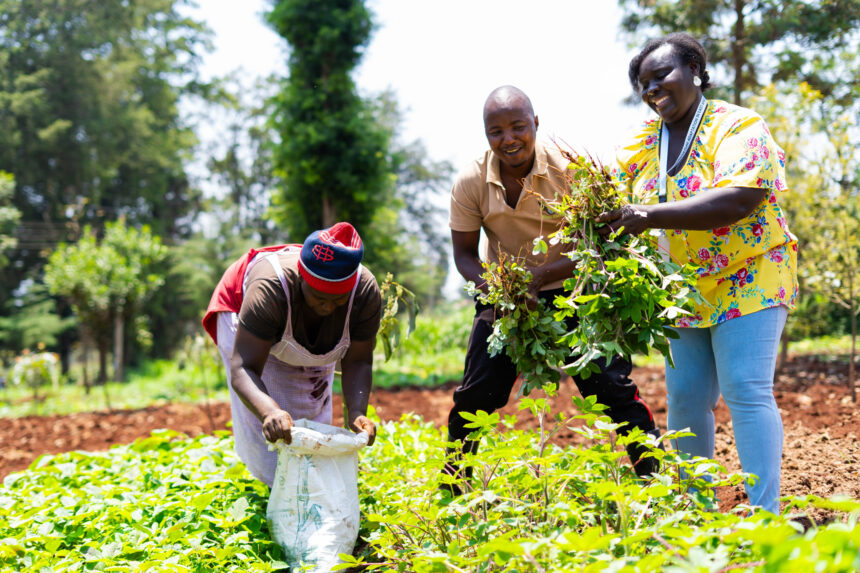
Smallholder farmers, often overlooked, have always developed their own ways of adapting to climate change impacts that not only deteriorate their produce but also take a psychological and mental toll.
New research reveals the staggering scale of this challenge that is rarely spoken about or looked into. According to a study by Climate Focus for the Family Farmers for Climate Action, smallholders require US$443 billion a year to build resilience, equivalent to an annual average of US$952 for a one-hectare farm.
The research comes at a timely period when the world is heading for the COP30 Climate Summit, with an emphasis that adaptation costs must be a central issue at the upcoming UN Climate Summit.
Notably, smallholder farmers working small plots of land are the unsung heroes of the climate and nature crises. They are forced to invest significant time and money to adapt, often in ways that help people and nature thrive together, dwarfing the contributions from rich governments.
Elizabeth Nsimadala, President of the Eastern Africa Farmers Federation, pointed out that meeting this adaptation gap isn’t charity, rather “it’s an investment in the food security of people right around the globe.”

The conversation on finance reveals that the amount is far less than the $470 billion a year the UN estimates is spent on agriculture subsidies that are harmful to the planet, and a third of the US$1.4 trillion developing countries spent on debt servicing in 2023.
Currently, global spending on smallholder adaptation amounts to just US$1.59 billion, a mere 0.36% of what’s needed. Consequently, the average smallholder farmer spends 20-40% of their annual income on adaptive measures, totaling US$368 billion a year.
This revelation is backed by the UN’s Adaptation Gap report, which states that spending on adaptation needs to increase by 10 to 18 times to help the most vulnerable communities.
While adaptation is high on the agenda at COP30, the current list of indicators lacks specific metrics on finance flows to smallholder farmers. Questions also remain over whether developed nations will deliver on their promise to double adaptation finance.
“Investing in smallholders is not only an economic necessity, it’s an ecological imperative,” said Thales Mendonça, an agroforestry farmer from Brazil. Thales further said that they are pioneering practices such as agroecology that build climate resilience by restoring nature’s safety net.
“Supporting smallholder farmers and our organizations to scale up this work is the fastest route from scarcity to abundance,” said Thales.
For smallholder farmers, adaptation means changing farming hours, improving soils, protecting natural areas, and attending training courses.
Esther Penunia, Secretary-General of the Asian Farmers’ Association, urged governments to agree to a major boost in adaptation finance. Pointing out that one of the most effective measures is to get more finance directly to smallholders through their own organizations.
“To achieve this, governments and funders must make it easier for family farmer organizations to directly access finance, and back the creation of a new dedicated Farmers Resiliency Fund – led by family farmers’ organizations,” said Penunia.
