
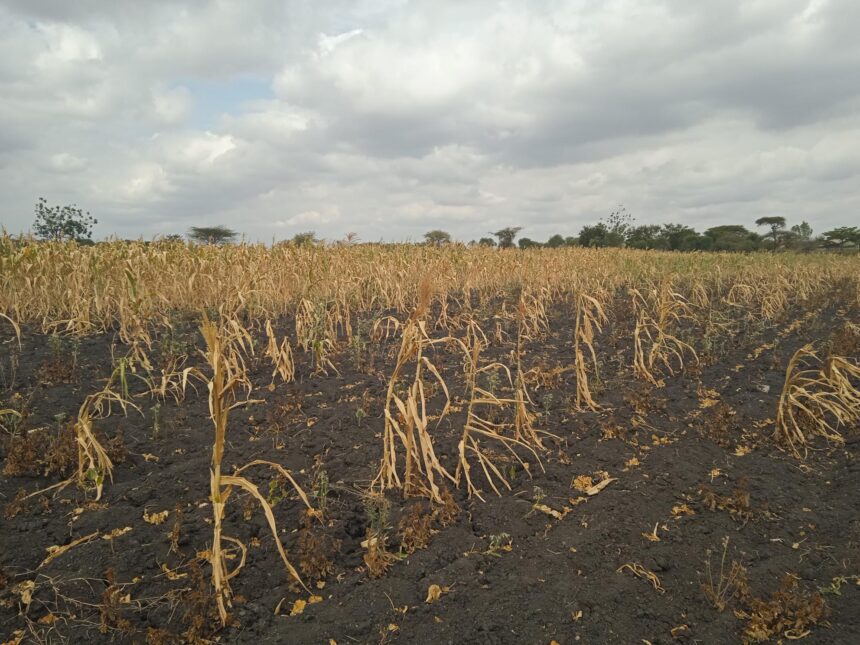
Millions of people across Sudan and Somalia are now just one failed season away from famine, even as other parts of Africa enjoy a sudden agricultural windfall.
By Alida Ban Pavlovic, One Planet Agency
Good harvests in parts of southern Africa are helping lift regional cereal production above its recent average, but worsening drought, heat and conflict are putting food supplies under growing pressure elsewhere on the continent.
The region is expected to produce about 43.4 million tonnes of cereals this season, almost 10% above its five year average, according to the latest assessment by the European Commission’s Joint Research Centre.
South Africa is forecast to harvest 10% more maize than its five year average, while Zambia expects a record 4.94 million tonnes. Zimbabwe is also expecting a modest increase from last season.
The stronger harvests have been helped by favourable rainfall, which has also supported livestock production across much of the region. But the gains are uneven.
Prolonged dry conditions in Angola and flooding in Mozambique have already reduced local yields. South Africa has completed its winter wheat planting under favourable conditions, although the wider outlook remains sensitive to changes in rainfall and temperature.
Further north and east, the picture is much more difficult.
East Africa is facing a combination of extreme heat, dry spells and worsening seasonal conditions. Sudan, South Sudan, Ethiopia, Eritrea and Somalia are among the countries expected to experience prolonged drought.
Forecasts from the Intergovernmental Authority on Development’s climate centre and the European Union’s Copernicus Climate Change Service point to below average rainfall through September.
For farmers who depend heavily on seasonal rains, a poor forecast can quickly become a food security problem.
In Sudan, the effects are compounded by a war that has displaced millions of people and disrupted farming, markets and humanitarian access. The latest assessment by the Integrated Food Security Phase Classification says almost 19.5 million people were facing high levels of acute food insecurity between February and May.
It warned that 14 areas across North Darfur, South Darfur and South Kordofan remain at risk of famine if conflict worsens and access to food and aid deteriorates.
“Conditions are expected to deteriorate further in the upcoming June to September lean season,” the IPC said.
West Africa is also showing a mixed picture.
Maize crops in southern areas have benefited from early rains and remain in relatively good condition ahead of the August harvest. But rainfall deficits in Senegal, Mali and Burkina Faso delayed the start of planting in parts of the Sahel.
Poor crop conditions have also been reported in Nigeria and Chad. Around 54.8 million people in the region are already facing food insecurity linked to conflict and climate shocks, according to the Food Security and Nutrition Working Group.
The outlook is particularly worrying for pastoralists, with drier than average conditions expected across much of the Sahel through September.
The contrast between strong harvests and worsening food insecurity shows how uneven the impact of changing weather has become across Africa.
North Africa is seeing a more positive season. Wheat production in Algeria, Morocco and Tunisia is expected to recover strongly after several years of poor harvests. Morocco faced delays and localised flooding earlier in the season, but the overall outlook has improved.
Outside Africa, farmers are also seeing sharply different conditions.
Pakistan, Bangladesh and Sri Lanka are expecting strong rice and maize production after favourable weather. Central Asia has reported good winter cereal conditions, while Afghanistan has also had a positive harvest outlook following regular rainfall.
Latin America faces a split picture similar to Africa’s. Parts of Central America, the Caribbean and northern South America are experiencing severe heat and drought, while the Pacific coast of South America faces a greater risk of flooding and landslides.
The latest assessment highlights a growing challenge for food systems. Good rainfall in one region can produce bumper harvests while heat, drought or floods elsewhere push farmers and consumers deeper into crisis.
For Africa, the concern is that climate shocks are increasingly interacting with conflict, displacement and weak markets.
In countries such as Sudan and South Sudan, even a good agricultural season may not be enough to protect people when farmers cannot safely reach their land or food cannot move through disrupted markets.
The IPC says the food crisis in Sudan is being driven not only by weather but also by conflict and restrictions on humanitarian access.
That makes the continent’s food outlook less a question of how much rain falls than whether farmers can turn favourable conditions into food that reaches the people who need it.
OPA New Agency
