One Planet AgencyOne Planet AgencyOne Planet Agency
  • Home
  • Climate News
    • Politics
    • Justice
    • Finance
    • Business
    • Nature
    • Science
    • Carbon Markets
    • Explainers
    • Series
    • All news
  • Climate Tech
    • AI and climate
    • Campaigns
    • Companies
    • Innovations
    • Science
    • Training
  • Green Markets
  • People & Voices
    • Interviews
    • Opinion
    • Women
    • Guest Writers
  • Energy
  • Deep Dives
    • Investigate
    • Expert Opinion
    • Analysis
  • Multimedia
    • Pictures
    • Videos
    • Podcast
Reading: Kenyan Scientist at ICIPE Reveals Research on Plastics Eating Insects
Share
Notification Show More
Font ResizerAa
Font ResizerAa
One Planet AgencyOne Planet Agency
  • Home
  • Climate News
  • Climate Tech
  • Green Markets
  • People & Voices
  • Energy
  • Deep Dives
  • Multimedia
  • Home
  • Climate News
    • Politics
    • Justice
    • Finance
    • Business
    • Nature
    • Science
    • Carbon Markets
    • Explainers
    • Series
    • All news
  • Climate Tech
    • AI and climate
    • Campaigns
    • Companies
    • Innovations
    • Science
    • Training
  • Green Markets
  • People & Voices
    • Interviews
    • Opinion
    • Women
    • Guest Writers
  • Energy
  • Deep Dives
    • Investigate
    • Expert Opinion
    • Analysis
  • Multimedia
    • Pictures
    • Videos
    • Podcast
Have an existing account? Sign In
Follow US
One Planet Agency > Blog > Energy > Kenyan Scientist at ICIPE Reveals Research on Plastics Eating Insects
Energy

Kenyan Scientist at ICIPE Reveals Research on Plastics Eating Insects

By Marcus Kiprop Last updated: January 6, 2025 5 Min Read
Share
plastics

The triple planetary crisis faced on a global scale has plastics playing an integral role in its disruption that has seen science continue giving predictions and scientists on the forefront of seeking solutions. The plastics pollution crisis is having significant impacts on climate change, increasing biodiversity loss and accelerating pollution entirely.

Plastics are considered an easier mode of packaging globally despite their tremendous implications, hence the heightened calls by global leaders for the abolition of their production and use. However, this call has faced mixed reactions, evidenced by the failure of concessions during the fifth Intergovernmental Negotiating Committee (INC-5) meeting in Busan on the global plastics treaty.

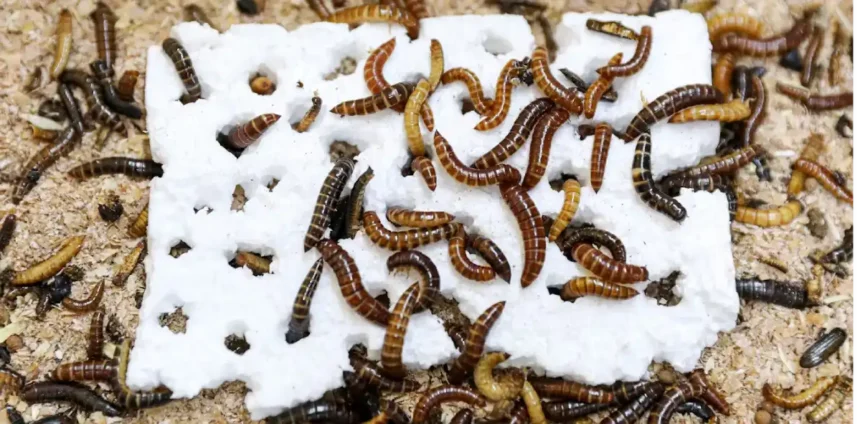
Recognizing the longevity of plastics in the environment, a scientist at the International Centre of Insect Physiology and Ecology (ICIPE) has delved into research on mealworm insects’ capability to fully digest plastics, hence a probable solution for pollution. Research shows that plastics can exist for more than 100 years in the environment.

Plastics, which have existed for over a century, are further affecting human health, wildlife in their ecosystems, and water bodies with limited fish species due to pollution directly and through microplastics that are ingestible unknowingly.

According to Dr. Fathiya Khamisi, a scientist at ICIPE, there is an elevation of some microbial consortia in the guts of the mealworm insects that is similar to what degrades the plastics.

“The mealworms have an elevation in their guts in that there’s no bio-accumulation of plastics in the body of the insects showing that they have a way of digesting it and releasing it into the environment. This makes them a potential solution for the plastics calamity,” she said.

ICIPE is researching mealworm insects to make them more sustainable if it is to solve the plastics pollution menace that is continuedly becoming uncontrollable and severe to existence. The aim is to ensure that there is a comprehension of what enzymes the insects produce which then break down the plastics into digestible forms within it.

“We will need a lot of mealworms to do the digestion that is for example we gave up to 150 mealworm insects 3.6 grams of Styrofoam to feed on which makes it economically unfeasible considering the costs,” said Dr. Fathiya.

Dr. Fathiya points out that their goal is finding out the enzyme or bacteria that does the degradation and harnessing it to make the process more feasible even if it means coming up with these consortia that can match the insect’s processing.

Plastics Implications on Triple Planetary Crisis

The process of plastic production involves the use of fossil fuels that emit greenhouse gases (GHG). The emissions are up to 85% in the production stage with the sourcing of its raw materials entailing 9% emitted and its waste management releasing up to 6% emissions. This advances the severity of climate change.

Once the plastic is tossed away, it influences biogeochemical cycles when modifying C storage in soils and marine ecosystems. In addition, plastics also affect climate change through the impact of Albedo by decreasing cryosphere light-absorbing properties.

In biodiversity loss, plastics impact the keystone species as they spur changes in fitness and species composition.  They further lead to habitat disturbances as they cause a change in nutrient cycling, physicochemical properties, and bioavailability of toxic compounds.

General plastic pollution is the most visible form in which plastic harm can be witnessed and this is from the contamination of soil, air, water, and water. This happens due to the leakages of particles and plastic-associated chemicals throughout the entire life cycle of plastics.

Source: Citizen TV Interview at ICIPE.

TAGGED: mealworms, plastics eating insects

Sign Up For Daily Newsletter

Be keep up! Get the latest breaking news delivered straight to your inbox.

By signing up, you agree to our Terms of Use and acknowledge the data practices in our Privacy Policy. You may unsubscribe at any time.
Marcus Kiprop January 6, 2025 January 6, 2025
Share This Article
Facebook Twitter Email Copy Link Print
What do you think?
Love0
Sad0
Happy0
Sleepy0
Angry0
Dead0
Wink0
Leave a comment Leave a comment

Leave a Reply Cancel reply

Your email address will not be published. Required fields are marked *

YOU MAY ALSO LIKE

Will cheap EVs from China wean Kenya off its second‑hand car dependence?

There is appetite for Chinese EVs but sparse charging infrastructure and taxes still discourage adoption. Seth Onyango and Derrick Opar,…

Climate NewsEast AfricaEnergyTechnology
April 15, 2026

Oil shock from Iran crisis clouds global shift to clean energy

Rising oil market turmoil linked to the Iran crisis is threatening to slow the global shift to renewable energy, as…

All newsClimateClimate NewsElectric VehiclesEnergyEnergyEnvironment
April 2, 2026

One Continent, Two Realities – Why MCB’s energy strategy cannot be the same for Mauritius and Africa

Thierry Hebraud CEO, MCB Ltd, One Planet Agency In a global context where positive developments are increasingly scarce, it is…

EnergyEnergy
March 2, 2026

Africa Calls for Climate Finance, Adaptation Support and Equity at COP30 Opening in Brazil

Belem, Brazil – November 12, 2025 The United Republic of Tanzania, speaking on behalf of the African Group, has called…

Electric VehiclesEnergyEnergy
January 21, 2026
We use our own and third-party cookies to improve our services, personalise your advertising and remember your preferences.
  • My Bookmark
  • Interests
  • Contact Us
  • Blog Index
  • Complaint
  • Advertise
  • Exclusives
  • Learn How
  • Support
  • Solutions
  • About Us
  • Terms And Conditions
  • Editorial Policy
  • Marketing Solutions
  • Industry Intelligence

Follow US: 

© 2025 One Planet Agency.  All rights reserved.

© 2025. All Rights Reserved. One Planet Agency
adbanner
AdBlock Detected
Our site is an advertising supported site. Please whitelist to support our site.
Okay, I'll Whitelist
Welcome Back!

Sign in to your account

Register Lost your password?