
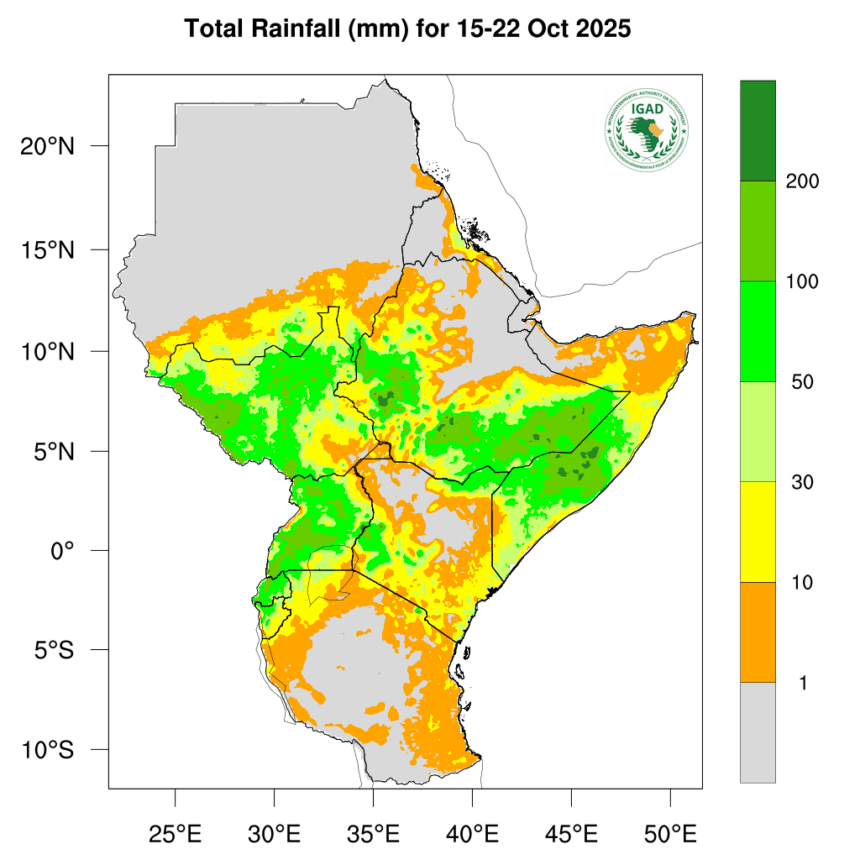
A significant weather pattern is expected to bring above-average rainfall and potential flooding to cross-border regions of Ethiopia and Somalia, while warmer-than-usual temperatures are forecast across the wider region for the third week of October 2025, according to a detailed climate outlook.
According to an IGAD Climate Predictions and Applications Center (ICPAC) forecast for 15-22 October 2025, issued for the Greater Horn of Africa (GHA), highlights a sharp divide in precipitation, with some areas bracing for exceptional rainfall and others for drier conditions.
Rainfall Anomalies and Flood Risks
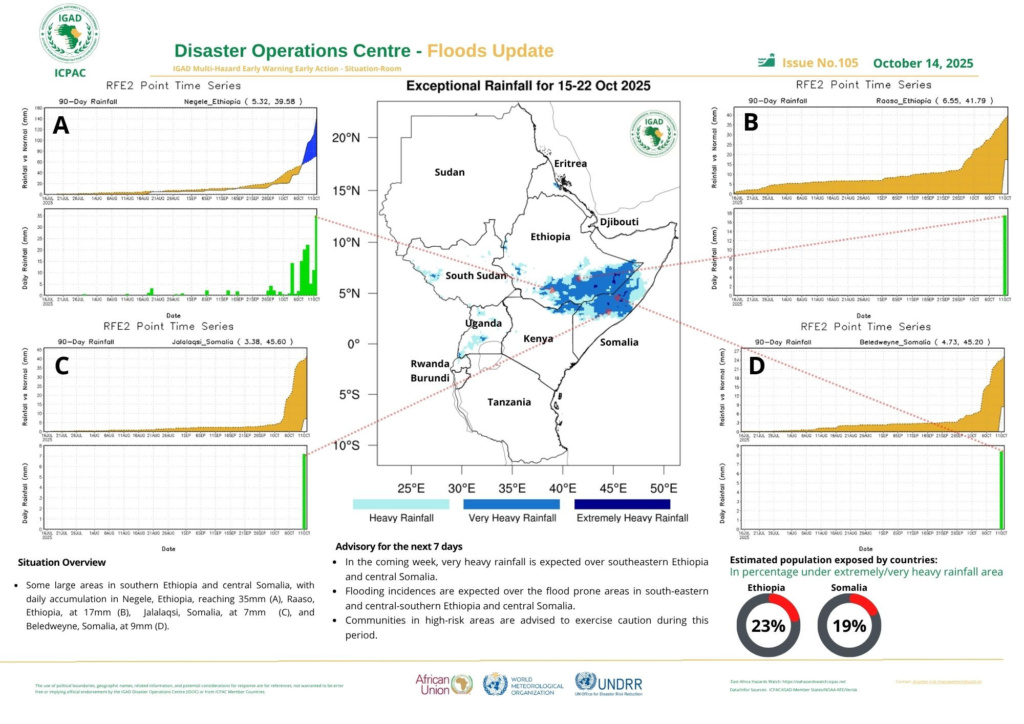
The most critical warning concerns exceptional rainfall, exceeding the 95th percentile of historical records, anticipated in the cross-border areas of south-eastern Ethiopia, central Somalia, and parts of north-eastern Kenya. This indicates a high probability of weather events that are historically rare for this time of year.
More broadly, moderate rainfall between 50-200mm is expected across Rwanda, Uganda, South Sudan, southern Ethiopia, central Somalia, and western Kenya. Conversely, lighter rainfall of less than 50mm is predicted for eastern and western Tanzania, southern and eastern Kenya, and northern Somalia.
When compared to seasonal averages, these patterns translate into significant anomalies. Central to northern South Sudan, southern Ethiopia, central Somalia, and parts of western Uganda and Kenya are expected to receive more rain than usual.

In contrast, drier-than-usual conditions are forecast for eastern Kenya, parts of Tanzania, and north-western Somalia.
The intense rainfall projections have raised direct concerns for public safety and infrastructure. The forecast indicates “a likelihood of flooding incidents” in flood-prone areas of south-eastern, central-southern Ethiopia, and central Somalia.
Elevated Temperatures and Heat Risks
Simultaneously, the region is expected to experience a spike in temperatures. Warmer-than-average temperatures are predicted across most of the GHA. The Afar region in Ethiopia is forecast to bear the brunt of the heat, with temperatures expected to exceed 32°C.
This has led to warnings of elevated heat stress levels in eastern Sudan, northern South Sudan, and the Afar region of Ethiopia, posing health risks to vulnerable populations. Only isolated areas, including south-eastern Ethiopia, are expected to experience cooler-than-average conditions.

This weather outlook presents a dual challenge for the affected regions. While some areas face the threat of flooding from heavy rains, others must prepare for heat stress and drier conditions.
Authorities in the highlighted zones are likely to issue localized advisories, emphasizing preparedness for potential displacement due to floods and public health measures to mitigate heat-related illnesses.
Note: 1 mm of rainfall is equivalent to 1 liter of water per square meter.

