
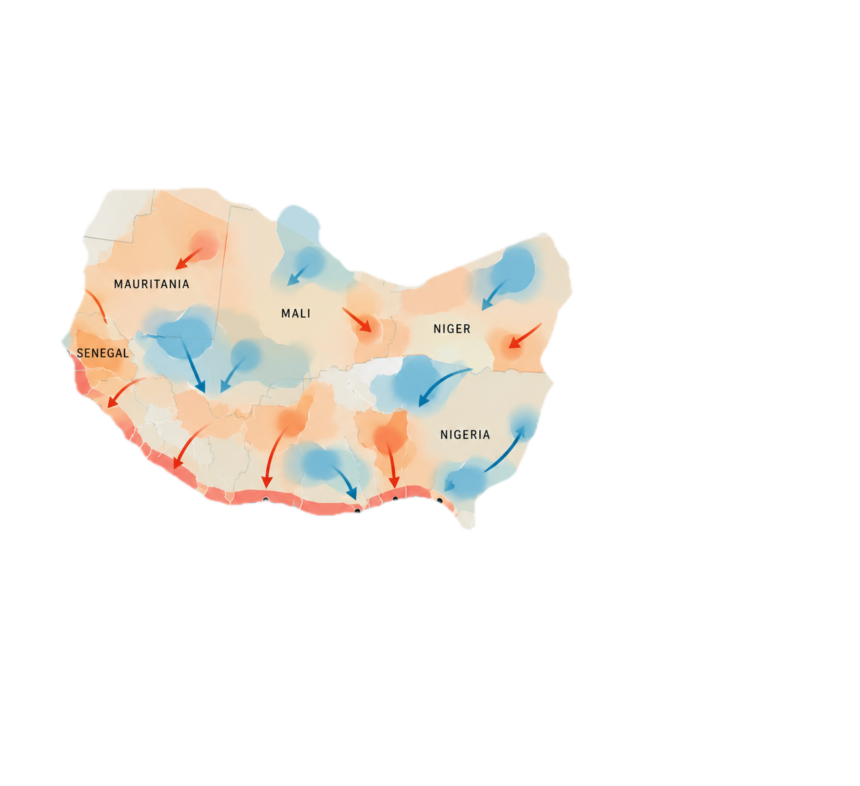
Climate change could reshape where millions of people live and work across West Africa over the next three decades.
Climate pressure is reshaping how people move across West Africa, with new internal migration routes expected to form within the next decade.
World Bank modelling shows that shifts in water access, crop yields and coastal conditions could create major mobility hotspots as early as 2030. The findings come from the bank’s Groundswell Africa analysis, released in 2021.
By 2050, up to 32 million people could become internal climate migrants across the region under a high-end scenario in which countries fail to take concrete climate and development action. The modelling covers movement within national borders rather than migration to Europe.
West Africa already has long-established patterns of mobility. Traders cross borders for markets, pastoralists move livestock in search of water and pasture, seasonal workers travel for jobs and families move from rural areas to cities. The World Bank modelling suggests climate change will add pressure to these existing movements as conditions change from one part of a country to another.
Water availability is the biggest climate-related driver in the model, followed by changes in crop productivity and ecosystem productivity. The projections also take account of demographic, economic and environmental factors that shape migration decisions.
Niger is projected to have the largest number of internal climate migrants in West Africa under the high-end scenario, at about 19.1 million by 2050. Nigeria follows with 9.4 million and Senegal with about 1 million. These figures describe people moving within their own countries as climate pressures affect where they can live and earn a living.
The direction of movement could change as well. South-central Mauritania, southeastern Mali and northern Nigeria are identified as potential areas of climate in-migration, while southern Niger, parts of the Mali-Mauritania border and sections of coastal Senegal could become out-migration hotspots. The model links these shifts to changes in water availability, pasture and other conditions that affect livelihoods.
Coastal communities face another source of pressure as seas rise and storm surges threaten homes and livelihoods. The World Bank estimates that between 300,000 and 2.2 million people living within 5 kilometres of the West African coast could move inland by 2050 because of these risks, depending on future emissions and other conditions. Senegal and parts of the Gulf of Guinea are among the areas with major projected coastal out-migration hotspots.
That movement would take place within a region where cities and coastal economies already draw people from inland areas. Dakar, Abidjan, Accra and Lagos have attracted migrants for jobs and services, while their coastal locations leave them exposed to flooding, erosion and rising seas.
The scale of projected internal movement is far larger than the current flow of West and Central Africans reaching Europe. IOM recorded 25,556 nationals from the two regions arriving irregularly in Europe during 2025. The agency also recorded 3,845 migrants who died or went missing along routes through the Mediterranean, Atlantic and Sahara that year.
The Atlantic route remains particularly deadly. IOM recorded 17,788 irregular arrivals to the Canary Islands in 2025, alongside 54 shipwrecks and 1,214 people reported dead or missing.
IOM’s World Migration Report 2026 places environmental disruption among the forces shaping migration worldwide. Floods, storms and other sudden events can trigger movement, while slower changes such as land degradation and changing environmental conditions can affect livelihoods over many years.
For West Africa, the World Bank projections point to a migration map increasingly shaped by access to water, productive farmland, pasture and safer coastal areas. Much of the movement is expected to take place within national borders, putting pressure on governments to plan for changing populations in cities, farming regions and communities across the Sahel and the coast.
One Planet Agency
