One Planet AgencyOne Planet AgencyOne Planet Agency
  • Home
  • Climate News
    • Politics
    • Justice
    • Finance
    • Business
    • Nature
    • Science
    • Carbon Markets
    • Explainers
    • Series
    • All news
  • Climate Tech
    • AI and climate
    • Campaigns
    • Companies
    • Innovations
    • Science
    • Training
  • Green Markets
  • People & Voices
    • Interviews
    • Opinion
    • Women
    • Guest Writers
  • Energy
  • Deep Dives
    • Investigate
    • Expert Opinion
    • Analysis
  • Multimedia
    • Pictures
    • Videos
    • Podcast
Reading: Eastern Africa Braces For Warmer, Drier Conditions in February
Share
Notification Show More
Font ResizerAa
Font ResizerAa
One Planet AgencyOne Planet Agency
  • Home
  • Climate News
  • Climate Tech
  • Green Markets
  • People & Voices
  • Energy
  • Deep Dives
  • Multimedia
  • Home
  • Climate News
    • Politics
    • Justice
    • Finance
    • Business
    • Nature
    • Science
    • Carbon Markets
    • Explainers
    • Series
    • All news
  • Climate Tech
    • AI and climate
    • Campaigns
    • Companies
    • Innovations
    • Science
    • Training
  • Green Markets
  • People & Voices
    • Interviews
    • Opinion
    • Women
    • Guest Writers
  • Energy
  • Deep Dives
    • Investigate
    • Expert Opinion
    • Analysis
  • Multimedia
    • Pictures
    • Videos
    • Podcast
Have an existing account? Sign In
Follow US
One Planet Agency > Blog > Climate News > Eastern Africa Braces For Warmer, Drier Conditions in February
Climate News

Eastern Africa Braces For Warmer, Drier Conditions in February

By Marcus Kiprop Last updated: January 22, 2026 4 Min Read
Share
Eastern Africa

Eastern Africa is expected to experience significant weather variations between February and April 2025, with IGAD Climate Prediction and Applications Center (ICPAC) projections indicating drier-than-usual conditions in some areas and above-average rainfall in others. The forecast also shows how temperatures across the region are set to rise, with some areas likely to experience extreme warmth.

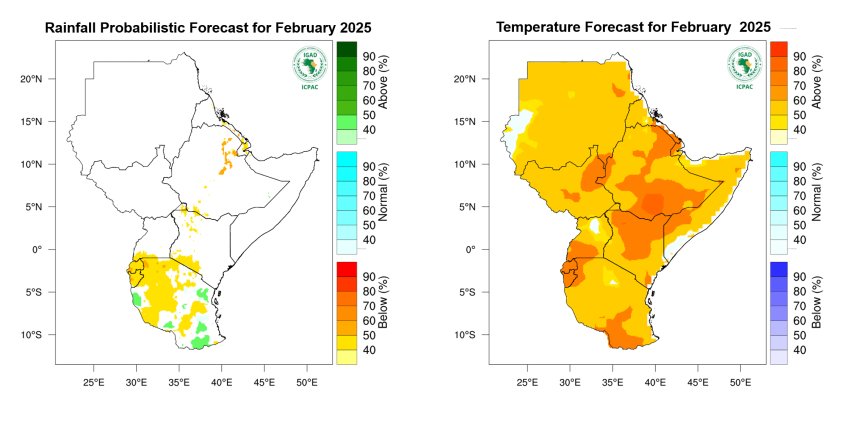
According to the latest forecast, February 2025 will bring drier-than-normal conditions to southwestern Kenya, Rwanda, Burundi, and most of Tanzania. However, central and southern Tanzania are expected to receive near-normal to above-average rainfall, offering some relief in an otherwise dry outlook.

Temperatures during this period are forecasted to be warmer than usual across the entire region with the most significant temperature increases expected in southern and northeastern Ethiopia, parts of eastern South Sudan, central and northern Kenya, southern Uganda, Rwanda, Burundi, and northwestern and southern Tanzania.

Notably, these areas are said to have a likeliness of experiencing prolonged heat, which may have implications for agriculture, water availability, and overall living conditions. However, despite the imbalances in regions’ reception of rainfall and heat, the broader February to April 2025 season, weather patterns are expected to remain mixed.

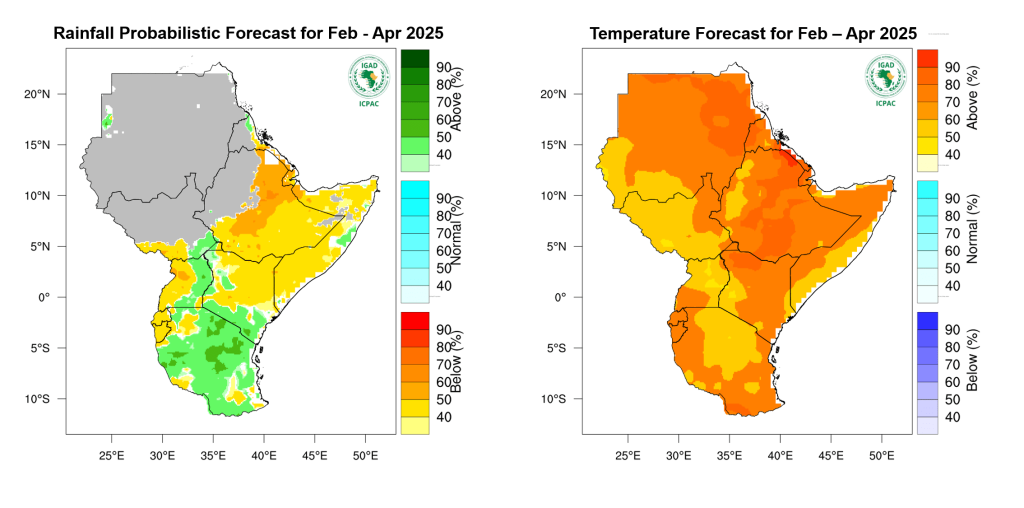
Drier-than-normal conditions are anticipated in Ethiopia, central and northern Kenya, central and western Uganda, parts of southern South Sudan, southern Eritrea, Djibouti, most parts of Somalia, Rwanda, Burundi, and select areas in Tanzania. These conditions are likely to pose challenges for farming communities that rely on seasonal rains for crop production.
Eastern Africa

In contrast, some regions are likely to see above-average rainfall with wetter-than-usual conditions forecast for western Kenya, eastern Uganda, southeastern South Sudan, southern Kenya, and most parts of Tanzania. The increased rainfall in these areas is beneficial as it might enhance the agricultural output and water resources but fear is are it may also heighten the risk of flooding and waterborne diseases.

Temperature trends for the February to April season show that the entire region is expected to experience above-average warmth, with the highest temperature increases projected in northern, eastern, and southern areas. This warming trend aligns with broader global climate patterns as witnessed with the year 2024 becoming the hottest on record and may exacerbate existing heat-related challenges, including drought stress and reduced water availability.

As weather patterns continue to shift in the Eastern Africa region, the IGAD Climate Prediction and Applications Centre (ICPAC) will provide regular regional updates. Meanwhile, national meteorological and hydrological services (NMHSs) will deliver more detailed forecasts at national and sub-national levels to help communities and policymakers prepare for the coming months.

Based on the forecast, both dry spells and heavy rains are expected hence governments, farmers, and local communities must take proactive measures to mitigate potential climate-related impacts. These would include; sustainable water management, early warning systems, and climate-smart agricultural practices will be crucial in adapting to these evolving conditions.

TAGGED: Forecast, ICPAC, ICPAC Prediction

Sign Up For Daily Newsletter

Be keep up! Get the latest breaking news delivered straight to your inbox.

By signing up, you agree to our Terms of Use and acknowledge the data practices in our Privacy Policy. You may unsubscribe at any time.
Marcus Kiprop January 22, 2026 February 3, 2025
Share This Article
Facebook Twitter Email Copy Link Print
What do you think?
Love0
Sad0
Happy0
Sleepy0
Angry0
Dead0
Wink0
Leave a comment Leave a comment

Leave a Reply Cancel reply

Your email address will not be published. Required fields are marked *

YOU MAY ALSO LIKE

African states finally team up for a bigger cut of carbon‑market billions

Countries are ramping up efforts to tap carbon markets through regional alliances and sector deals in aviation and shipping. By…

AfricaClimate NewsFinanceGreen MarketPolitics
April 16, 2026

Will cheap EVs from China wean Kenya off its second‑hand car dependence?

There is appetite for Chinese EVs but sparse charging infrastructure and taxes still discourage adoption. Seth Onyango and Derrick Opar,…

Climate NewsEast AfricaEnergyTechnology
April 15, 2026

Artemis II success exposes gaps in Africa’s climate monitoring systems

Across much of the continent, weather stations are sparse or offline, and data is not always accessible quickly enough for…

Climate NewsClimate Tech
April 15, 2026

Timing shields east and southern Africa from fertiliser price spike 

Africa’s exposure to a fertiliser price surge is uneven, with early planting before the war in Iran sparing some regions…

AfricaAgricultureClimate NewsWorld
April 9, 2026
We use our own and third-party cookies to improve our services, personalise your advertising and remember your preferences.
  • My Bookmark
  • Interests
  • Contact Us
  • Blog Index
  • Complaint
  • Advertise
  • Exclusives
  • Learn How
  • Support
  • Solutions
  • About Us
  • Terms And Conditions
  • Editorial Policy
  • Marketing Solutions
  • Industry Intelligence

Follow US: 

© 2025 One Planet Agency.  All rights reserved.

© 2025. All Rights Reserved. One Planet Agency
adbanner
AdBlock Detected
Our site is an advertising supported site. Please whitelist to support our site.
Okay, I'll Whitelist
Welcome Back!

Sign in to your account

Register Lost your password?