
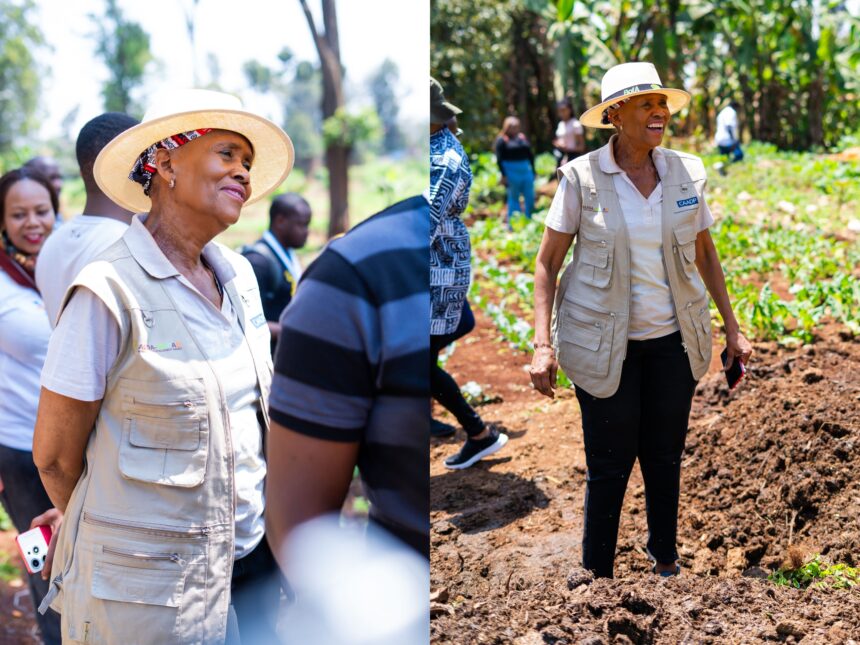
What began as a hobby driven by necessity has blossomed into a national award-winning enterprise for Diane Sibanda, chairperson of the Eastern and Southern Africa Smallholder Farmers’ Forum (ESAFF), a horticulture farmer from Greater Gaborone in Botswana. Her journey from corporate life to becoming a champion farmer and advocate offers a powerful blueprint for agricultural success in the face of adversity.
Sibanda’s entry into farming was, by her own account, a default decision. “It was by default, because my parents were farmers… and to me farming was a non-starter,” she recalls. With a conviction in farming, she started with land available and limited job opportunities, and she began farming as a hobby around 2010.
What started as a trial quickly turned into a calling, with several attempts at getting it right as she envisioned. This conviction would finally begin to bear fruit in 2012, with a wave of recognition, including champion prizes at agricultural shows and awards for the best plot in Greater Gaborone, solidifying her new path.
“This became a new chapter, a new journey from corporate to farming,” Sibanda said. Remarkably, she achieved this despite having no formal background in agriculture. “I had never studied agriculture. I just went into it. I studied from my farm laborers, and I became a guru over time with lots of resilience and curiosity.”
Her initial approach was one of “trial and error,” planting haphazard lines of various crops with limited success. A turning point, she reveals, occurred with the hiring of a farm manager, who introduced structured planning and rotational cropping.
Sibanda’s dedication to learning led her to cross into South Africa to source seeds and acquire spraying materials plus substances directly from manufacturers, while also visiting established South African farmers to learn of their best practices and their knowledge.
This commitment to continuous improvement refined her business model to the extent of garnering immense expertise that she now specializes in high-value crops, operating a sophisticated system.
“In my farm, I grow tomatoes in the tunnels. I do cucumbers… and herbs in the shade net,” she explained. In open fields, she focuses on hardy crops like watermelon, butternut, and specifically hybrid onions, which reach maturity in two and a half months instead of six.

She opines that this strategic focus on quality allows her to supply exclusively to upmarket shops, ensuring better returns, which further sustain the farm even more.
Reflecting on the broader perception of farming in Botswana, Sibanda distills its essence into three core principles: passion, dedication, and perseverance.
“Farming is three things. Passion, dedication, and perseverance. If you don’t have passion and perseverance in farming, you can’t make it,” she stated.
She describes the very real challenges farmers face, from floods and droughts to heat waves that can wipe out an entire season’s work. “If you are not passionate, you go home… But if you are passionate, you wipe your tears, and you throw your weight into the field again.”
Her message to the younger generation in a food-insecure continent with abundant arable land is to embrace these three traits. “If you have those three as a farmer, you are a winner,” she advises, while cautioning that “farming is not for the lighthearted.”
Comparing her experience in Botswana to other regions, Sibanda notes the distinct challenges posed by her country’s climate, yet important enough is how farmers have maneuvered around these issues.
“Botswana is extremely dry. The rains are erratic… Horticulture farmers and other farmers in the country are struggling with water.” However, despite these hurdles, she and her peers press on, driven by the same perseverance she champions.
Her final message to fellow farmers is one of purpose and prosperity as she urges more people on the continent to venture into agriculture. “You can’t do anything without farming, and the riches are in farming,” Sivanda said.
“We feed the nation, and you can’t go hungry if you are a farmer. You always have something to feed your family, your neighbors, your community, and the world,” she concluded.

I am happy to have this inspiration.