One Planet AgencyOne Planet AgencyOne Planet Agency
  • Home
  • Climate News
    • Politics
    • Justice
    • Finance
    • Business
    • Nature
    • Science
    • Carbon Markets
    • Explainers
    • Series
    • All news
  • Climate Tech
    • AI and climate
    • Campaigns
    • Companies
    • Innovations
    • Science
    • Training
  • Green Markets
  • People & Voices
    • Interviews
    • Opinion
    • Women
    • Guest Writers
  • Energy
  • Deep Dives
    • Investigate
    • Expert Opinion
    • Analysis
  • Multimedia
    • Pictures
    • Videos
    • Podcast
Reading: IGAD Releases Climate Forecast for March to May 2025
Share
Notification Show More
Font ResizerAa
Font ResizerAa
One Planet AgencyOne Planet Agency
  • Home
  • Climate News
  • Climate Tech
  • Green Markets
  • People & Voices
  • Energy
  • Deep Dives
  • Multimedia
  • Home
  • Climate News
    • Politics
    • Justice
    • Finance
    • Business
    • Nature
    • Science
    • Carbon Markets
    • Explainers
    • Series
    • All news
  • Climate Tech
    • AI and climate
    • Campaigns
    • Companies
    • Innovations
    • Science
    • Training
  • Green Markets
  • People & Voices
    • Interviews
    • Opinion
    • Women
    • Guest Writers
  • Energy
  • Deep Dives
    • Investigate
    • Expert Opinion
    • Analysis
  • Multimedia
    • Pictures
    • Videos
    • Podcast
Have an existing account? Sign In
Follow US
One Planet Agency > Blog > Electric Vehicles > IGAD Releases Climate Forecast for March to May 2025
Electric VehiclesEnergyEnergy

IGAD Releases Climate Forecast for March to May 2025

By Marcus Kiprop Last updated: January 21, 2026 4 Min Read
Share
March to May

The IGAD Climate Prediction and Applications Centre (ICPAC) has released its seasonal climate forecast for March to May (MAM) 2025, a timespan that is essential for the equatorial parts of the Greater Horn of Africa. The season contributes up to 60% of annual rainfall in many areas, which dictates the outcome of agricultural activities, water resources availability, and livelihoods.

According to a Research Scientist at ICPAC Masilin Gudoshava, the region focused on is largely dependent on agriculture hence through the forecasting, a farmer gets awareness that in turn informs their crop selection.

“Farmers are enabled to know when the rainfall is more than 300mm or less and therefore inform them which gives early warning preparedness for what awaits. This is made possible by our online dashboards like the Agricultural Monitoring Watch, and Earth Hazards Watch among regular forecasts shared on a monthly and weekly basis,” said Masilin.

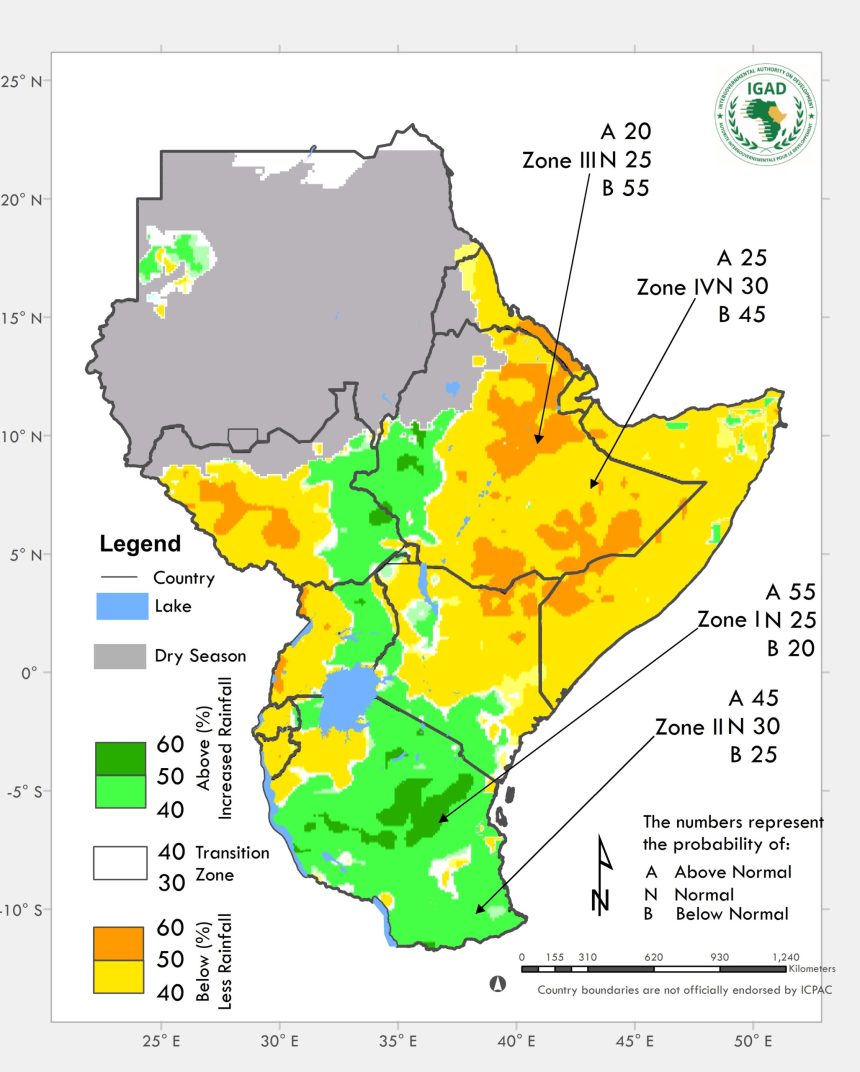
The forecast indicates a higher likelihood of below-normal rainfall in several regions, particularly in Somalia, eastern and northern Kenya, southern and northeastern Ethiopia, Djibouti, coastal Eritrea, western South Sudan, and southern and western Uganda.

The same is predicted for Rwanda, Burundi, and northwestern Tanzania. Additionally, drier-than-usual conditions are expected in cross-border areas of Ethiopia, Kenya, and Somalia, as well as northeastern Ethiopia and southern Eritrea.

march to may
An Illustration of the rainfall patterns during the season

In contrast, wetter-than-normal conditions are likely in most of Tanzania, eastern Uganda, eastern South Sudan, and western Ethiopia. There is also a high probability that rainfall will exceed 200 mm in southwestern Ethiopia, western Kenya, Uganda, Rwanda, Burundi, and Tanzania hence early forecasting for preparedness.

Dr. Abdi Fidar, ICPAC’s Officer-in-Charge, emphasized the importance of collaborative efforts in addressing climate risks most importantly because they are transboundary in occurrence. “As the IGAD region faces increasing climate variability—droughts, floods, and rising temperatures—platforms like GHACOFs are essential for fostering cooperation and preparedness,” he said.

He also highlighted the role of climate services in closing the early warning gap, stressing the need for accurate, timely information to enhance disaster response and resilience.

The temperature projections show a strong likelihood of warmer-than-normal conditions across much of the region, with the highest probabilities in Sudan, Ethiopia, Eritrea, Djibouti, northern Somalia, and northern Kenya.

While most areas are expected to experience an early or normal start to the rainy season, some localized regions in central Kenya, southern Ethiopia, and central Somalia may see delays.

March to May
An illustration of the forecast temperature shifts between March to May

The expected climatic conditions are likely to have significant social and economic impacts, with vulnerable populations like women, children, the elderly, and persons with disabilities facing heightened risks. ICPAC has urged stakeholders to take proactive measures to mitigate these effects by embracing early warning and preparedness for climate shocks.

H.E. Mr. Motumma Mekasa, State Minister and Advisor to Ethiopia’s Minister of Water and Energy, acknowledged IGAD’s role in advancing the calls for regional integration and being an agent of driving climate action.

He commended its efforts in not only working to address climate change but also educating the skills. Emphasizing the importance of institutionalizing climate services to support sustainable development and protect livelihoods.

The March to May 2025 seasonal forecast was developed using January 2025 projections from nine Global Producing Centres (GPCs), following objective forecasting procedures recommended by the World Meteorological Organization (WMO).

TAGGED: ICPAC, IGAD, IGAD Climate Prediction and Applications Centre, MAM, March to May

Sign Up For Daily Newsletter

Be keep up! Get the latest breaking news delivered straight to your inbox.

By signing up, you agree to our Terms of Use and acknowledge the data practices in our Privacy Policy. You may unsubscribe at any time.
Marcus Kiprop January 21, 2026 January 25, 2025
Share This Article
Facebook Twitter Email Copy Link Print
What do you think?
Love0
Sad0
Happy0
Sleepy0
Angry0
Dead0
Wink0
Leave a comment Leave a comment

Leave a Reply Cancel reply

Your email address will not be published. Required fields are marked *

YOU MAY ALSO LIKE

Report: Oil shock squeezes Africa but rerouted shipping offers limited gains to some

Rising fuel and shipping costs are tightening pressure on African economies, though rerouted traffic is offering brief gains in some…

AfricaClimate NewsEnergy
April 20, 2026

Will cheap EVs from China wean Kenya off its second‑hand car dependence?

There is appetite for Chinese EVs but sparse charging infrastructure and taxes still discourage adoption. Seth Onyango and Derrick Opar,…

Climate NewsEast AfricaEnergyTechnology
April 15, 2026

Oil shock from Iran crisis clouds global shift to clean energy

Rising oil market turmoil linked to the Iran crisis is threatening to slow the global shift to renewable energy, as…

All newsClimateClimate NewsElectric VehiclesEnergyEnergyEnvironment
April 2, 2026

Kenyan manufacturers ramp up efficiency under stricter rules

Kenyan manufacturers are moving fast to cut waste and sharpen efficiency as tighter rules take hold. Officials say the changes…

Climate NewsEast AfricaEnergy
March 9, 2026
We use our own and third-party cookies to improve our services, personalise your advertising and remember your preferences.
  • My Bookmark
  • Interests
  • Contact Us
  • Blog Index
  • Complaint
  • Advertise
  • Exclusives
  • Learn How
  • Support
  • Solutions
  • About Us
  • Terms And Conditions
  • Editorial Policy
  • Marketing Solutions
  • Industry Intelligence

Follow US: 

© 2025 One Planet Agency.  All rights reserved.

© 2025. All Rights Reserved. One Planet Agency
adbanner
AdBlock Detected
Our site is an advertising supported site. Please whitelist to support our site.
Okay, I'll Whitelist
Welcome Back!

Sign in to your account

Register Lost your password?