
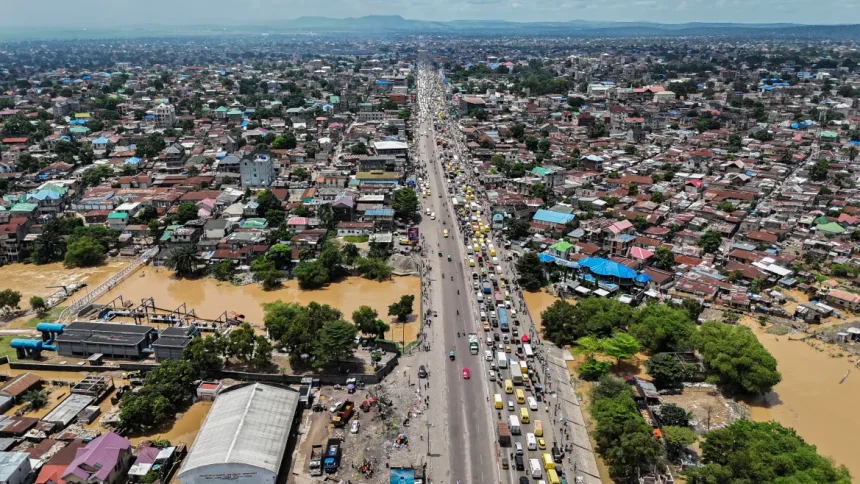
Kinshasa suffered devastating floods on April 4-5 this year, which submerged homes and killed at least 33 people and displaced thousands. The disaster was triggered when the N’Djili and Nsuenge rivers east of the city burst their banks, submerging the major bridge by up to 3 meters, with private boats used for evacuation.
This disaster, which has affected half of Kinshasa, 26 districts, is not a one-off, as in 2022, more than 100 people died in floods following a similarly heavy downpour. African scientists attribute this to unreliable datasets.
“Because of high uncertainty in global satellite weather datasets and climate models’ outputs, we couldn’t do a full attribution analysis to determine the role of climate change,” said, Team Leader of the intra-ACP Climate Services Programme of the Organization of African, Caribbean and Pacific States.
He added that this failure highlights a deeper problem, emphasizing that climate science has long overlooked much of Africa, particularly the Central African rainforest region.
The Killer Floods That Weren’t ‘Unusual’
According to a report by the World Weather Attribution, from a hazard point of view, the event as observed in 2025 is not rare. Similar periods of heavy rainfall are expected to occur on average every second year in today’s climate, which has been warmed by 1.3°C.
The report states that the three gridded datasets used in the analysis show different trends, including one that suggests climate change made the event much more likely, while two show no change.
Scientists have attributed this to the scarcity and inaccessibility of meteorological data, as well as the inadequate performance of climate models. This has meant that they cannot confidently evaluate the role of climate change in the rainfall that led to flooding.
For instance, during the early 2010s, weather station reports from much of the DRC were no longer transmitted to the Global Telecommunication System, leading to huge data gaps. Moreover, data from Kinshasa stations is only available until 2023. Satellite and reanalysis-based rainfall products show clear discrepancies, indicating limited agreement.
This has meant that accurately quantifying changes in precipitation and its associated uncertainty remains a challenge, particularly across the Central African region, where rain gauge networks are sparse and unevenly distributed.
As Africa bears the burden of climate change, the necessary tools are missing to help in the mitigation and adaptation processes.
“Africa contributes just 3–4% of global emissions, but is getting pummeled by extreme weather and still isn’t receiving funding for adaptation promised by wealthy countries at global climate summits,” said Dr Joyce Kimutai, Researcher at the Centre for Environmental Policy, Imperial College London.
Dr. Friederike Otto, Imperial College London, highlighted that climate change makes it harder for fragile states to get ahead. He said, “With every fraction of a degree of fossil fuel warming, the weather will get more violent, creating a more unequal world.”
Global Climate Justice
According to the WWA, climate science has focused on extreme weather events in wealthy countries, meaning the changing risks of events in many African countries are not well understood, while the continent has only contributed 3-4% of global emissions.
In November, COP29 agreed that rich countries will raise their financial support to help developing countries cope with climate change to $300 billion by 2035. However, in the years before COP29, rich countries consistently failed to deliver the adaptation finance promised for developing countries, throwing the COP29 pledge into uncertainty.
The exploitation of vulnerable countries like the DRC for natural resources to drive the global economy has further worsened the already dire situation. The WWA findings highlight that despite being one of the most mineral-rich countries in the world, with over half of the global cobalt supply, a key element in batteries and the global transition to renewable energy, the DRC remains the fourth poorest country globally.
“Even after gaining independence, its vast minerals industry, critical for the renewable transition, continues to be dominated by foreign businesses and in recent months, has been the target of brutal rebel violence,” said Dr. Otto.
In recent months, violence has intensified in the DRC, resulting in thousands of deaths and displacing nearly seven million people. Instability places additional pressure on national systems, particularly as displaced populations move westward.
To improve preparation and adaptation to the ever-changing weather patterns, scientists advise that there is a need to invest in weather monitoring stations and climate science to understand the changing weather extremes in Central Africa.
“Africa needs more attribution studies. We need to understand how our countries are being impacted by climate change and prepare for the future,” says DR. Kimutai.
Highlighting the case of Kinshasa, Shaban Mwenda of the Red Cross Climate Centre said that the city needs to prepare for periods of extreme rainfall.
“There is a need for stronger laws and policies on critical sectors such as risk management and settlements for flood risk management,” he said.
Findings indicate that flood risk is amplified by rapid population growth, limited infrastructure coverage, and high reliance on informal systems. Drainage is frequently blocked by waste pollution, and there is limited waste management and sewage maintenance, in Kinshasa.
While progress is being made, for example, the drafting of a new law on the DRC’s town planning and construction code, more comprehensive efforts are needed.
