
Climate change impacts are a significant driver of conflicts, which result in climate mobility and an increase in climate refugees.
Climate change is driving more frequent and severe disasters, including droughts, floods, hunger, cyclones, and heatwaves, with each season more intense than the last.
These impacts contribute to the escalation of conflicts, which can be inter-tribal, inter-regional, or cross-border, and often result in increased human displacement.
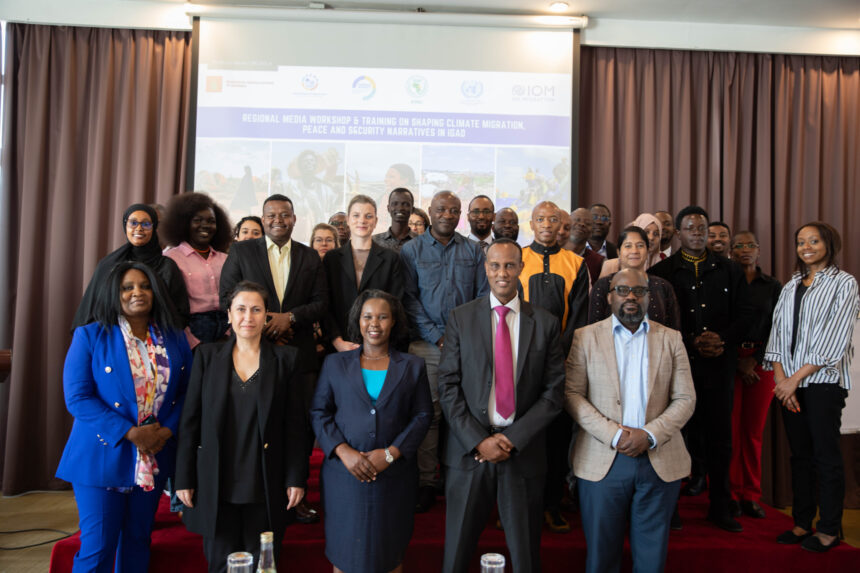
In a convening by the International Organization for Migration (IOM), in partnership with the Intergovernmental Authority on Development’s Climate Prediction and Applications Center (ICPAC) and the Office of the United Nations Special Envoy for the Horn of Africa, the nexus of climate change, peace, and security became a subject of discussion.
Within the two-day regional media workshop in Nairobi, we endeavored to understand the interconnectedness of climate change, human mobility, peace, and security in the IGAD region.
Clarity on the issue of conflict’s correlation with climate change outcomes revealed a clear link to undermined livelihoods and intensified competition over land, pasture, and water.
The Human Cost of Climate-Induced Displacement
It became apparent that human mobility is a direct result of the arising conflicts. We often end up in situations where the most vulnerable members of society are forced to flee, becoming internally displaced people or climate refugees.
Although the term “climate refugee” is controversial, it reflects the undeniable reality that climate change impacts are causative of such predicaments.
According to Nihan Erdogan, IOM Deputy Regional Director for East, Horn, and Southern Africa, it’s important to comprehend that climate change is at the core of all of these risk-multiplier impacts.
She revealed that IOM is on the frontline in working with member states and regional economic communities like IGAD to enhance comprehension so that mobility is considered in climate action plans, given the crystal-clear connection.

“It’s a complex matter to unpack, hence the journalists here are called on to share their experiences so that we create synergies with you, as the media acts as a bridge between the evidence and the understanding of people. This meeting is pegged on your role, since it’s through your stories that citizens, policymakers, and stakeholders can act in an informed manner backed with evidence,” she said.
Based on the 2024 Global Report on Internal Displacement, of the 7.8 million displaced across Sub-Saharan Africa due to disasters, more than 1.4 million were within IGAD member states.
Yet these data, similar to IGAD’s Conflict Early Warning and Response Mechanism (CEWARN) and other specialized units, and ICPAC’s, provided climate risk analyses, early warnings, and policy guidance to help governments and communities respond to droughts, floods, and other climate-related shocks, tend not to reach audiences in a manner that can inform accurate action.
Bridging the Gap Through Media
As pointed out by Dr. Abdi Fidar, Director of IGAD-ICPAC, it’s important that journalists can humanize these stories and data, considering ICPAC, among other institutions, produces lots of data that should be used to inform the citizens.
“Communication is the missing link since we produce lots of accurate, factual data that needs to be translated to simpler language that the audience can easily and clearly understand,” he added.

Dr. Fidar emphasized that journalists are the most crucial link for their mastery of the language that citizens, including policymakers, easily relate to. Hence, their focus on merely presenting this information is vital.
The communication of climate change events is, in most instances, mainstreamed, as seen in cases of floods disrupting livelihoods and claiming lives.
However, this coverage often falls short of bringing out the nexus between these events and their long-term consequences, such as migration, hunger, and famine resulting from the loss of livestock and crops.
The conversation leaning on the nexus between climate change, migration, security, and peace is essential, as data shows that over 36 million people in the Horn of Africa were affected by droughts between 2021 and 2023.
More than 2.5 million people were displaced due to climate-related events in the region in 2024 alone, with projections indicating that by 2050, the impacts could lead to the displacement of up to 86 million people across Sub-Saharan Africa.
A complexity arises since these issues intersect and play out differently depending on context, with stark variances between urban and rural areas, sedentary and nomadic societies, and arid and humid regions.
This implies that solutions for the region have to be context-based in order to be effective and productive.
This need for context-based solutions is being recognized at the policy level, a reality that the Honorable Debora Mlongo Barasa, the Cabinet Secretary for Environment, Climate Change, and Forestry of the Republic of Kenya, affirmed in reflection of member states ratifying regional policy processes like the Kampala Ministerial Declaration on Migration, Environment and Climate Change (KDMECC).
“This is a one-of-a-kind regional policy framework, a landmark recognition of the nexus between climate change and human mobility, as it recognizes that climate mobility represents both humanitarian and sustainable development challenges and opportunities,” said CS Deborah.
The Media’s Mandate Going Forward
The CS representative, Ms. Wangari, urged the media to play its crucial role in informing citizens and professionals on the most pressing challenges of our time, which is the intersection of climate change, mobility, peace, and security.

She shared her lived experience being a resident of the Rift Valley at a time when climate change impacted her family and community as a whole. Her emphasis was on the need for amplification of these issues to enable appropriate actions for resilience of the communities on the frontlines.
This convention marked a critical step, as it focused on developing the capacity of journalists to report responsibly on matters of climate mobility. The goal is to amplify voices from affected communities and foster dialogue between policymakers, journalists, and technical experts.
A dialogue that opens up on the work of IOM, ICPAC, OSE Horn, the Ministry of Foreign Affairs of Denmark, among other partners, toward ensuring that mobility is integrated into climate action, disaster risk reduction, and peacebuilding efforts.
