One Planet AgencyOne Planet AgencyOne Planet Agency
  • Home
  • Climate News
    • Politics
    • Justice
    • Finance
    • Business
    • Nature
    • Science
    • Carbon Markets
    • Explainers
    • Series
    • All news
  • Climate Tech
    • AI and climate
    • Campaigns
    • Companies
    • Innovations
    • Science
    • Training
  • Green Markets
  • People & Voices
    • Interviews
    • Opinion
    • Women
    • Guest Writers
  • Energy
  • Deep Dives
    • Investigate
    • Expert Opinion
    • Analysis
  • Multimedia
    • Pictures
    • Videos
    • Podcast
Reading: The Future of Dairy Is Low-Carbon: East Africa’s Path to Climate Resilience
Share
Notification Show More
Font ResizerAa
Font ResizerAa
One Planet AgencyOne Planet Agency
  • Home
  • Climate News
  • Climate Tech
  • Green Markets
  • People & Voices
  • Energy
  • Deep Dives
  • Multimedia
  • Home
  • Climate News
    • Politics
    • Justice
    • Finance
    • Business
    • Nature
    • Science
    • Carbon Markets
    • Explainers
    • Series
    • All news
  • Climate Tech
    • AI and climate
    • Campaigns
    • Companies
    • Innovations
    • Science
    • Training
  • Green Markets
  • People & Voices
    • Interviews
    • Opinion
    • Women
    • Guest Writers
  • Energy
  • Deep Dives
    • Investigate
    • Expert Opinion
    • Analysis
  • Multimedia
    • Pictures
    • Videos
    • Podcast
Have an existing account? Sign In
Follow US
One Planet Agency > Blog > Agriculture > The Future of Dairy Is Low-Carbon: East Africa’s Path to Climate Resilience
AgricultureAnimalsFood

The Future of Dairy Is Low-Carbon: East Africa’s Path to Climate Resilience

By Editorial Desk Last updated: October 17, 2025 3 Min Read
Share

Reducing emissions is one of the most crucial steps toward healing the planet from the effects of climate change.

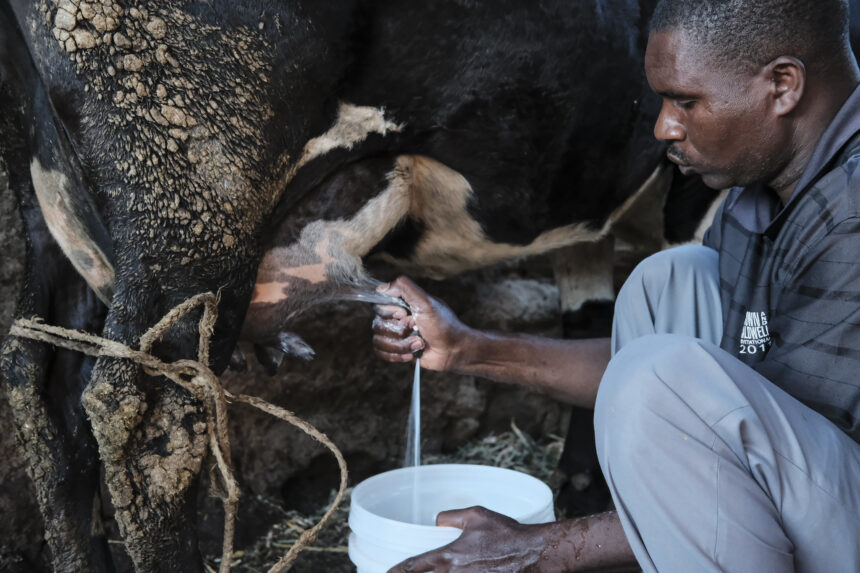
The livestock supply chain industry, which according to the Food and Agriculture Organization (FAO) contributes about 14.5% of global greenhouse gas emissions, is now taking a major leap in East Africa through the Dairy Interventions for Mitigation and Adaptation (DaIMA) programme, a $358 million initiative led by the International Fund for Agricultural Development (IFAD) with significant co-financing from the Green Climate Fund (GCF).

The livestock supply chain, contributes about 14.5% of global greenhouse gas emissions

Presented at the recently concluded 9th International Greenhouse Gas and Animal Agriculture (GGAA) conference in Nairobi, the initiative will directly benefit 2.5 million rural people in Kenya, Rwanda, Tanzania, and Uganda, and indirectly reach an additional 15.4 million individuals along the dairy value chain.

According to Michel Mordasini, IFAD Vice President, smallholder farmers are a key part of the solution to the climate change challenge, “and with the right investments, smallholders can feed a growing planet while at the same time restoring degraded ecosystems and reducing agriculture’s carbon footprint.”

Smallholder farmers are a key part of the solution to the climate change challenge

This initiative will strengthen the productivity and efficiency of East African Dairy systems by equipping smallholder farmers with climate information, improved breeding and veterinary services, better reproduction and feed management, and innovative technologies to enhance productivity while cutting emissions.

Already operational through four IFAD projects aligned with national priorities in the target countries, the program seeks to restore nearly 180,000 hectares of rangeland and support more than two million dairy cattle.

“DaIMA is about transforming the backbone of East Africa’s dairy sector,” said Sara Mbago, Regional Director, East and Southern Africa, IFAD. “By combining innovation, investment, and policy reform, we are helping farmers adapt to a changing climate while reducing emissions and creating growth opportunities.”

DaIMA preparation brings together a powerful coalition of partners, including IFAD, GCF, International Livestock Research Institute (ILRI), the FAO Investment Center, the Global Methane Hub, the Global Dairy Platform, and USAID Food and Agriculture. 

Moreover, the initiative prioritizes inclusion, putting women, youth, and marginalized groups at the heart of climate action to ensure they benefit equally from the transformation.

As a regional center of excellence through its Mazingira Center, ILRI will provide technical assistance to the four countries on monitoring, reporting, and verification of greenhouse gas emissions.

According to ILRI Director General Appolinaire Djikeng, “The DaIMA program represents a major milestone for the dairy sector. By scaling up low-emission, climate-resilient solutions, it directly supports the implementation of the Paris Agreement and accelerates the sustainable transformation of the region’s dairy industry.”

Read also: Carbon Dioxide Concentrations Surge to New Highs, WMO Warns

TAGGED: Livestock

Sign Up For Daily Newsletter

Be keep up! Get the latest breaking news delivered straight to your inbox.

By signing up, you agree to our Terms of Use and acknowledge the data practices in our Privacy Policy. You may unsubscribe at any time.
Editorial Desk October 17, 2025 October 17, 2025
Share This Article
Facebook Twitter Email Copy Link Print
What do you think?
Love0
Sad0
Happy0
Sleepy0
Angry0
Dead0
Wink0
Leave a comment Leave a comment

Leave a Reply Cancel reply

Your email address will not be published. Required fields are marked *

YOU MAY ALSO LIKE

Timing shields east and southern Africa from fertiliser price spike 

Africa’s exposure to a fertiliser price surge is uneven, with early planting before the war in Iran sparing some regions…

AfricaAgricultureClimate NewsWorld
April 9, 2026

Kenyan farmers retain right to traditional seed after court victory

Despite the latest victory, the government has signalled its intention to pursue a full appeal to overturn the ruling in…

AgribusinessAgricultureClimate News
March 5, 2026

African farmers to report carbon emissions under new global rules

New standards and upcoming guidance are expected to boost the credibility and consistency of climate reporting, ensuring farm emissions and…

AgricultureClimate
March 4, 2026

‘Climate-smart’ billions fuel chemical-heavy farming in Africa, report 

Nearly half of the African Development Bank’s portfolio is now labelled climate finance. Funds billed as climate resilience are flowing…

AfricaAgribusinessAgricultureAnalysis
February 27, 2026
We use our own and third-party cookies to improve our services, personalise your advertising and remember your preferences.
  • My Bookmark
  • Interests
  • Contact Us
  • Blog Index
  • Complaint
  • Advertise
  • Exclusives
  • Learn How
  • Support
  • Solutions
  • About Us
  • Terms And Conditions
  • Editorial Policy
  • Marketing Solutions
  • Industry Intelligence

Follow US: 

© 2025 One Planet Agency.  All rights reserved.

© 2025. All Rights Reserved. One Planet Agency
adbanner
AdBlock Detected
Our site is an advertising supported site. Please whitelist to support our site.
Okay, I'll Whitelist
Welcome Back!

Sign in to your account

Register Lost your password?